
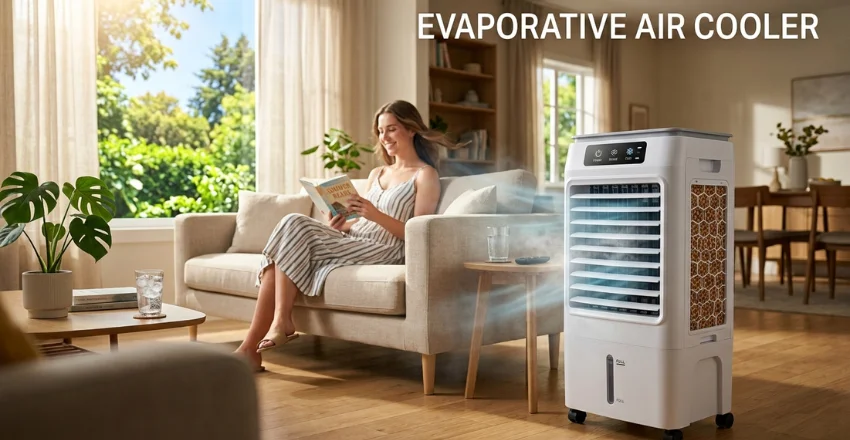
An evaporative air cooler can look like an attractive middle ground between a basic fan and expensive air conditioning. It uses water and moving air rather than a refrigeration system, so it generally consumes much less electricity than portable air conditioning. However, its effectiveness depends heavily on humidity, which makes choosing one for a UK home more complicated than simply comparing tank sizes and fan speeds.
For British households, the key question isn’t whether evaporative cooling works at all, because the physics is well established. The real question is whether it will work well enough in your room and in the weather conditions when you need cooling most. Understanding that limitation can help you avoid buying a low-energy appliance that does not deliver the type of cooling you expected.
Direct answer: An evaporative cooler can help in a UK home when the weather is warm and relatively dry, particularly for personal or small-area cooling. It costs little to run compared with portable air conditioning, but because it adds moisture to the air, its cooling effect becomes weaker as humidity rises.
What Is an Evaporative Air Cooler?
An evaporative cooler is an electrical appliance that cools air by passing it across or through water-saturated material. Most portable models combine a fan, water reservoir, pump and absorbent cooling pad inside one movable unit. The UK government’s Energy Technology List defines evaporative coolers as devices that cool air through water evaporation and distinguishes between direct and indirect systems.
The domestic models commonly sold in Britain are usually direct evaporative coolers. Water keeps an internal pad damp, while a fan pulls warm air through that pad and pushes the resulting cooler, more humid airflow into the room. They usually don’t include the compressor, refrigerant circuit, or hot-air exhaust hose found in a portable air conditioner.
How Does Evaporative Cooling Work?
Evaporation needs energy, and it takes some of that energy from the heat in the incoming air. As warm air passes over the wet cooling medium, a small amount of water changes from liquid to vapour and absorbs heat during that process. The air leaving the appliance can therefore be cooler than the air entering it, although it also contains more moisture.
This is why the weather matters so much. Relatively dry air can hold more additional water vapour, allowing more evaporation, while humid air already carries substantial moisture and has less capacity for further evaporation. The Met Office also explains that high relative humidity limits evaporation, which is why humid heat can feel particularly uncomfortable.
Do Evaporative Air Coolers Work in the UK?
Yes, but their performance varies much more than refrigerated air conditioning. A warm, dry afternoon gives an evaporative cooler favourable conditions, while a muggy day gives the same appliance much less opportunity to cool through evaporation. That means UK buyers should expect weather-dependent relief rather than thermostat-controlled cooling.
The Health and Safety Executive describes evaporative cooling as moderately reducing air temperature while increasing humidity. That distinction is useful because marketing can sometimes make portable water-based coolers sound interchangeable with air conditioning. They are not, and expecting a compact cooler to transform a hot room like an air conditioner is likely to cause disappointment.
A practical way to judge likely performance is to consider both temperature and humidity, not temperature alone. Even during a heatwave, an already humid room offers less evaporative potential than a hot but comparatively dry space. Ventilation also matters because repeatedly circulating the same increasingly humid air can further reduce the benefit.
| Conditions in the room | Likely evaporative-cooler experience | Practical verdict |
|---|---|---|
| Hot and relatively dry | Strongest evaporative effect | Good conditions for this technology |
| Warm with moderate humidity | Noticeable airflow with modest cooling | Can be worthwhile for personal cooling |
| Hot and muggy | Limited additional cooling | A fan or air conditioner may suit the goal better |
| Existing damp or condensation problem | Added moisture may be undesirable | Usually a poor match |
| Well-ventilated workshop or conservatory | Fresh air can support continued evaporation | Often a more suitable use case |
Evaporative Air Cooler vs Fan vs Portable Air Conditioner
A fan is the simplest option because it moves existing room air rather than actively lowering its temperature. Moving air helps sweat evaporate from the skin, so a fan can make a person feel cooler even when the room stays at roughly the same temperature. An evaporative cooler goes one step further by using water evaporation to reduce the temperature of the airflow it produces.
A portable air conditioner works differently because it uses a refrigeration cycle to remove heat from indoor air and expel that heat outdoors. It can therefore provide stronger, more predictable temperature control while also removing moisture from the air during operation. The trade-off is substantially greater electricity consumption, a higher purchase price and the need to vent hot air outside.
| Feature | Fan | Evaporative air cooler | Portable air conditioner |
|---|---|---|---|
| Actively cools airflow | No | Yes, through evaporation | Yes, through refrigeration |
| Effect on humidity | Little direct effect | Adds moisture | Usually removes moisture |
| Exhaust hose required | No | No | Yes |
| Best operating conditions | Most normal indoor conditions | Hotter, drier conditions | Hot or humid conditions |
| Energy use | Very low | Low | Much higher |
| Whole-room temperature control | No | Limited | Yes, when correctly sized and vented |
| Typical role | Personal comfort | Low-energy local cooling | Reliable room cooling |
Energy Saving Trust’s 2026 figures illustrate the running-cost difference clearly. It estimates typical continuous 24-hour use in Great Britain at about £0.14–£0.30 for a fan, £0.27–£0.39 for an evaporative cooler and £4.62–£5 for portable air conditioning, although individual appliances and tariffs vary. Northern Ireland has a separate electricity market and different typical costs.
Is an Evaporative Air Cooler Worth Buying in the UK?
An evaporative cooler makes the strongest case when you value low power consumption, portability and direct cooling more than precise room-temperature control. It may suit a home office, conservatory, garage or workshop where fresh-air ventilation is available, and you mainly want a cooler breeze directed towards occupied areas. It can also make sense for occasional dry heat rather than as a guaranteed solution for every warm day.
The low operating cost is another genuine advantage. You can often run this type of appliance for long periods without approaching the electricity consumption of a compressor-driven portable air conditioner. However, cheap operation only represents good value when the appliance provides enough comfort for your particular room and expectations.
It becomes a weaker purchase if your main problem is a consistently hot, humid bedroom that needs to reach and maintain a set temperature. The same applies to homes already dealing with condensation, persistent damp or excess indoor humidity because a direct evaporative cooler introduces additional water vapour. In those circumstances, stronger temperature control or dehumidification may be more useful than additional evaporation.
Why Humidity Matters So Much
Relative humidity describes how close the air is to holding as much water vapour as it can at its current temperature. When relative humidity is lower, incoming air can accept more water vapour evaporating from a cooling pad. As humidity increases, evaporation slows, and the potential temperature reduction shrinks.
This is one reason a product can receive very different reviews from different households. Someone using the appliance during dry afternoon heat may experience a noticeably cooler stream of air, while another person running it during muggy weather may feel little difference beyond normal fan movement. Neither experience necessarily means the appliance is faulty; the operating conditions may simply be different.
The added moisture also changes how a room feels. HSE guidance notes that high humidity limits the body’s ability to lose heat through sweat evaporation, which means simply adding moisture is not automatically beneficial during hot weather. A good evaporative-cooling setup therefore needs both airflow and adequate ventilation rather than a sealed room gradually becoming more humid.
How to Use an Evaporative Cooler Properly
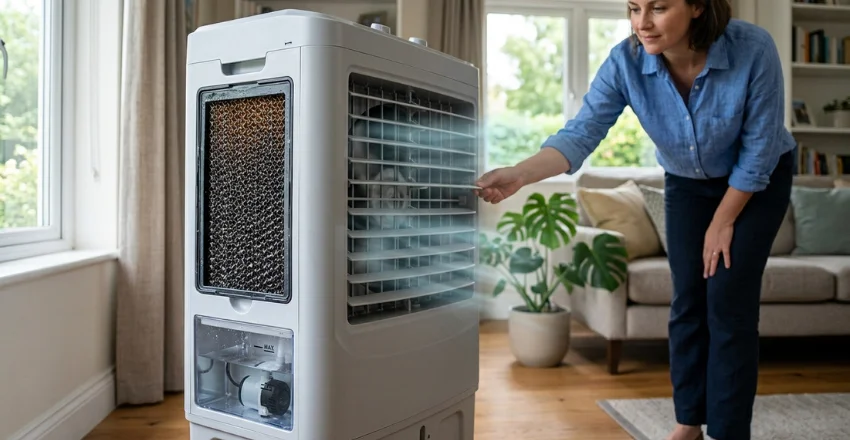
Positioning is more important than many owners expect. An evaporative cooler generally performs better when it has access to fresh air and when the cooled airflow can travel directly towards the people using the room. Placing it in a completely sealed room can allow humidity to build up, reducing the evaporative effect over time.
External ventilation should therefore remain available in accordance with the appliance manufacturer’s instructions. At the same time, you do not necessarily want hot air freely entering from every part of the property, so controlling internal doors can help keep the cooling focused on the occupied space. Energy Saving Trust specifically advises keeping rooms well ventilated because evaporative appliances increase indoor moisture.
Product advertising often focuses on water temperature, especially when reusable ice packs are included. Colder water or ice packs may make the initial airflow feel cooler, but they do not change the fundamental limitation imposed by humid air. Treat ice as an optional boost, not proof that a water-based cooler can perform like refrigerated air conditioning.
What to Look for When Buying an Evaporative Air Cooler
Start with the room and how you intend to use the appliance rather than choosing the model with the longest feature list. A larger water tank reduces refill frequency, but it also makes the appliance heavier, while high airflow is useful only if noise remains acceptable in the space where you work or sleep. Easy access to the tank and cooling media is particularly valuable because these components need regular cleaning.
Useful features to compare include:
- Power consumption: Lower wattage generally means lower operating costs, but compare airflow alongside watts.
- Water-tank capacity: A larger reservoir can reduce refilling during long periods of use.
- Fan-speed settings: Several speeds make it easier to balance cooling, airflow and noise.
- Swing or oscillation: Moving louvres can distribute airflow across a wider occupied area.
- Timer and sleep settings: These are particularly useful in bedrooms and home offices.
- Noise rating: Check the manufacturer’s specification if you are sensitive to sound at night.
- Cleaning access: Tanks, filters and cooling pads should be straightforward to reach and maintain.
- Castors or handles: Mobility matters if you plan to use one appliance in several rooms.
- Warranty length: A longer guarantee can provide extra reassurance for an appliance with a pump, fan and moving parts.
Do not rely on terms such as “mini air conditioner” or “personal AC” without checking the actual technology inside the product. If the unit uses only a water tank, wet filter, small pump, and fan, it is an evaporative cooler regardless of how the packaging describes it. A genuine portable air conditioner typically specifies refrigeration capacity and requires a way to exhaust heat outside.
Reduce the Heat Entering Your Home First
Cooling appliances work better when they are not fighting unnecessary solar heat throughout the day. Closing blinds or curtains on sun-facing windows and preventing strong sunlight from heating internal surfaces can reduce the amount of heat that later needs to be removed. Energy Saving Trust recommends blocking daytime solar gains and introducing cooler outdoor air when conditions become favourable, particularly later in the evening or overnight.
Solar-control film is another option for rooms that regularly overheat through exposed glazing. Wordify’s guide to custom-cut window film explains how solar-control products can reduce the heating effect of sunlight while fitting into a wider DIY window project. Reducing heat gain can sometimes improve comfort more effectively than simply buying a larger cooling appliance.
Longer-term home improvements can also change how much mechanical cooling you need. Wordify’s guide to heating options for UK homes discusses air-to-air heat pumps, which can provide heating and cooling in suitable properties, while the HVAC installation guide explains why system sizing and airflow matter. These solutions involve very different costs and installation requirements, but they are worth understanding if summer overheating has become a recurring problem.
Cleaning and Maintenance
Because an evaporative cooler repeatedly circulates water, regular maintenance is part of ownership, not an optional extra. Emptying stale water, cleaning the tank, and maintaining the cooling pad according to the manufacturer’s instructions helps prevent unpleasant smells, mineral deposits, and declining performance. Hard-water areas may require particular attention to scale accumulation.
Also dry and clean the appliance before long-term winter storage. Leaving water sitting in the reservoir for extended periods is unnecessary and can make the next use unpleasant. Always follow the model-specific manual for filter replacement, pad cleaning and any recommended descaling process rather than applying strong household chemicals without guidance.
Evaporative Coolers and Hot-Weather Safety
An appliance can improve comfort, but it should not be treated as the only protection during severe heat. NHS guidance recommends keeping living spaces cool, staying hydrated, closing windows and blinds when outdoor conditions are hotter, and opening windows when outside temperatures fall. Older people, young children, pregnant people and those with some long-term health conditions can be particularly vulnerable during heatwaves.
UKHSA also recommends reducing heat entering the home during the hottest part of the day and creating airflow when cooler outdoor air becomes available. If somebody develops symptoms of heat exhaustion or heatstroke, changing fan settings or adding more ice to a cooler is not an adequate response. Hot-weather health guidance and appropriate medical help should take priority over appliance troubleshooting.
Frequently Asked Questions
Does an Evaporative Air Cooler Actually Cool a Room?
It can lower the temperature of the air passing through the appliance, especially when conditions are hot and relatively dry. However, the effect is usually more limited and less predictable than refrigerated air conditioning because it depends on evaporation and, therefore, humidity. View it as enhanced low-energy airflow rather than guaranteed whole-room climate control.
Do You Need to Open a Window With an Evaporative Cooler?
Some fresh-air ventilation is normally beneficial because direct evaporative cooling continually introduces moisture into the air. Letting humid indoor air escape helps keep the room from getting progressively damper and less suitable for evaporation. Always follow the manufacturer’s ventilation instructions for your model.
Is an Evaporative Cooler Better Than a Fan?
It can be better when the air is dry enough for evaporation to provide an additional cooling effect. A standard fan uses even less energy and may provide perfectly adequate personal comfort without adding moisture to the room. If conditions are already humid, the simpler fan can therefore be the more sensible choice.
Is an Evaporative Cooler Cheaper to Run Than Air Conditioning?
Yes, typical evaporative coolers use substantially less electricity than compressor-driven portable air conditioners. Energy Saving Trust’s 2026 comparison places their typical running cost much closer to ordinary fans than to portable air conditioning. The trade-off is that lower electricity use comes with much more limited, weather-dependent cooling performance.
Can You Use an Evaporative Cooler in a Bedroom Overnight?
You can if the appliance is designed for continuous operation, maintained correctly and used with suitable ventilation. Noise, rising humidity and water-tank capacity should all be considered before leaving it running for many hours. In a muggy bedroom, a quiet fan or properly vented air conditioner may provide better comfort depending on whether your priority is airflow or actual temperature reduction.
Does Adding Ice Make an Evaporative Cooler Much Colder?
Ice packs or cold water can temporarily cool the water reservoir and may make the outgoing breeze feel fresher. They cannot overcome high humidity because the appliance still relies mainly on water evaporation to produce its cooling effect. Choose a cooler for its airflow, usability and suitability for your climate rather than because the box prominently advertises ice packs.
The Verdict: Should You Buy One?
An evaporative air cooler can be a sensible UK purchase when you understand exactly what it does. It offers low-energy airflow with some genuine evaporative cooling during favourable conditions, requires no hot-air exhaust hose and is generally inexpensive to operate. For personal cooling in a ventilated room, workshop, conservatory or home office, that may be all you need.
It is not a replacement for air conditioning when your priority is reliably reducing and controlling room temperature throughout humid summer weather. Check your room’s humidity, think about existing damp problems and decide whether you need personal relief or genuine whole-room cooling before spending money. That simple distinction is more useful than choosing a model based on tank size, ice packs or marketing claims alone.