
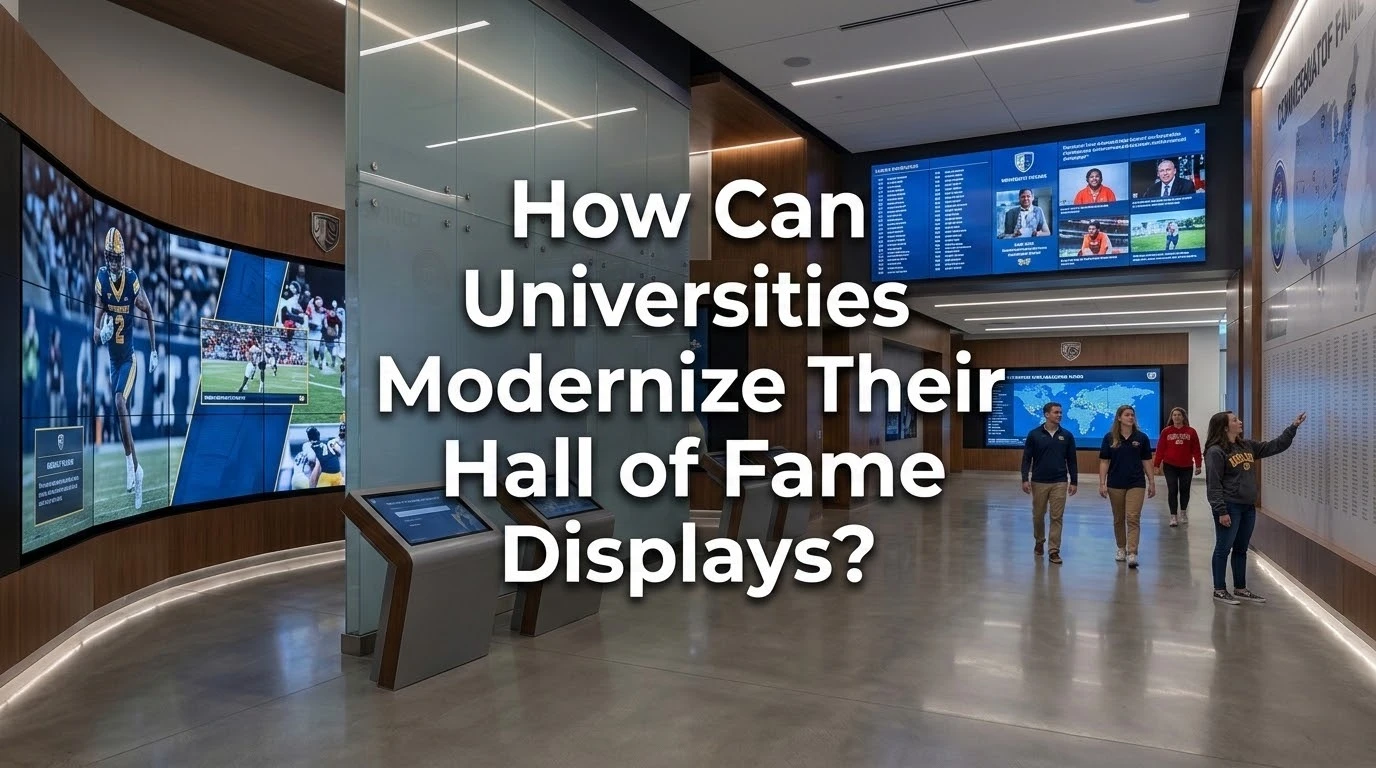
A lot of university Hall of Fame displays still do one job well: they put names and faces on a wall. The problem is that today’s students, alumni, recruits, and visitors expect more than a static plaque and a row of framed photos. They want context. They want stories. They want to search, browse, and engage on their own terms.
That shift matters because athletic history, academic distinction, donor recognition, and institutional legacy all compete for attention across campus. If a Hall of Fame display looks frozen in time, people walk past it. If it feels current and easy to explore, it becomes part of the campus experience.
Start with Experience, Not Screen
The biggest mistake is treating modernization as a hardware project. A university buys a large display, mounts it in a lobby, and assumes the job is done. Usually it isn’t.A modern Hall of Fame display should answer a simple question: what do visitors need to do when they walk up?
- Some want to search for a former teammate.
- Some want to browse championship teams by year.
- Some want to see video highlights, read athlete bios, or look up records before an event.
Prospective students and families may only spend two or three minutes with the display, so navigation has to make sense immediately. That means universities should map the visitor journey before they select software, screen size, or enclosure type. If the display is hard to use, the technology becomes expensive furniture.
Why Static Displays Fall Short
Traditional displays still have value. They create permanence, and in some spaces they fit the architecture better than digital alternatives. But they have real limits.Printed panels are hard to update. Adding new inductees often requires a designer, printer, installer, and budget approval. If the athletics department wants to add video, archival photos, or milestone timelines, physical displays run out of space fast. The more history an institution has, the more compressed the storytelling becomes.
Digital systems solve that space problem. A single screen can hold decades of records, hundreds of biographies, and media that would never fit on a wall. More importantly, it can make the archive usable instead of just visible.
Build Around Searchable History
Search is where digital Hall of Fame systems start earning their keep. Universities usually have more content than they realize such as team photos, game programs, newspaper clippings, championship brackets, coach profiles, award histories, and donor milestones. Without structure, that material becomes a digital junk drawer.
A better approach is to organize content around how people actually look for information:
- By athlete or honoree name
- By sport, department, or recognition type
- By graduation year or induction class
- By team achievement, record, or championship season
- By media type, such as photos, video, or articles
This is where interactive touchscreen software makes a real difference. It allows visitors to move quickly from a broad category to a specific person or moment without needing staff assistance. For universities, that means the display works during tours, alumni weekends, game days, and off-hours without constant supervision. If the system includes filters and a strong search function, even a large archive feels manageable.
Content Quality Matters More Than Flashy Effects
Prioritize content over visual gimmicks. While animated transitions and dramatic screens might look impressive initially, they often hinder visitors who want to find information quickly.Strong Hall of Fame content usually has a few basic traits:
- Short, readable bios
- Consistent formatting across profiles
- High-resolution images that are properly cropped
- Clear dates, honors, and statistics
- Video clips that load quickly and add real context
- Captions that explain why a moment matters
Universities also need editorial standards. Names should be formatted consistently. Records should match official sources. Archived material should be checked before publication, especially when content has been assembled over many years from different departments. This part isn’t glamorous, but it’s what makes the display trustworthy.
Plan for Updates Before Launch
The long-term success of a Hall of Fame display usually depends less on launch day and more on what happens six months later. Who updates inductees? Who uploads new media? Who checks for broken links, outdated branding, or missing records?
If there’s no ownership plan, the display starts strong and then slowly goes stale. This happens in athletics centers, student unions, and alumni buildings. The screen still works, but the content clearly stopped evolving.
A good operating model is simple:
- Assign one primary owner, usually in athletics, alumni relations, or marketing.
- Define who can submit updates and who approves them.
- Use templates for bios, awards, and team history entries.
- Schedule review points around induction ceremonies, major reunions, and season closeouts.
- Keep original media files organized in a shared archive.
This is also where interactive touchscreen kiosk software can help, especially when the display is part of a larger campus visitor environment. If the same platform supports multiple kiosks or content endpoints, teams can manage updates more consistently instead of maintaining disconnected systems in different buildings.
Think About Placement Like a Facility Operator
Location changes everything. A brilliant digital display in a low-traffic hallway won’t get much use. A decent display in the right place often performs better. Universities should evaluate placement based on traffic, dwell time, and context.
Good locations include:
- Athletics lobbies
- Arena and stadium concourses
- Alumni centers
- Student unions
- Library entry areas
- Admissions or visitor welcome spaces
Each location brings different behavior. In an athletics facility, visitors may already know what they’re looking for. In an admissions building, users may be browsing casually while waiting for a tour. Lighting matters too. So does accessibility. If users can’t comfortably reach the screen, read the text, or navigate without confusion, the display will underperform no matter how strong the content is.
Use the Display for More Than Recognition
A modern Hall of Fame display can do more than honor past achievements. It can support recruitment, fundraising, and institutional storytelling without turning into a sales pitch.
- For athletics, it reinforces program legacy.
- For advancement teams, it creates another venue for donor recognition.
- For admissions, it gives campus tours a stronger visual story.
- For alumni relations, it provides a focal point during reunions and events.
A system that supports daily campus engagement, event traffic, archival access, and cross-department storytelling has a much stronger operational case.
Keep the Interface Simple
This sounds obvious, but it gets missed all the time. Most visitors will not stand there and “learn” a complicated interface. They’ll tap once or twice, hesitate, and move on.
A good Hall of Fame interface should include:
- Clear top-level navigation
- Large touch targets
- Search that works with partial names
- Fast access to recent inductees and major records
- A visible home button
- Minimal on-screen clutter
If a user can find a person, a team, or a championship season in under a minute, the display is doing its job.
Modernization Works Best When it Respects Tradition
The strongest university Hall of Fame projects don’t erase tradition. They extend it. A digital system can preserve the visual weight of recognition while adding the depth that physical displays can’t handle on their own.
In many cases, the best solution is a hybrid one, permanent physical elements for institutional presence, paired with a digital display for search, media, and ongoing updates. That gives universities room to grow without rebuilding the wall every few years. Done well, a Hall of Fame display becomes more than a recognition piece. It becomes a campus asset people actually use.