

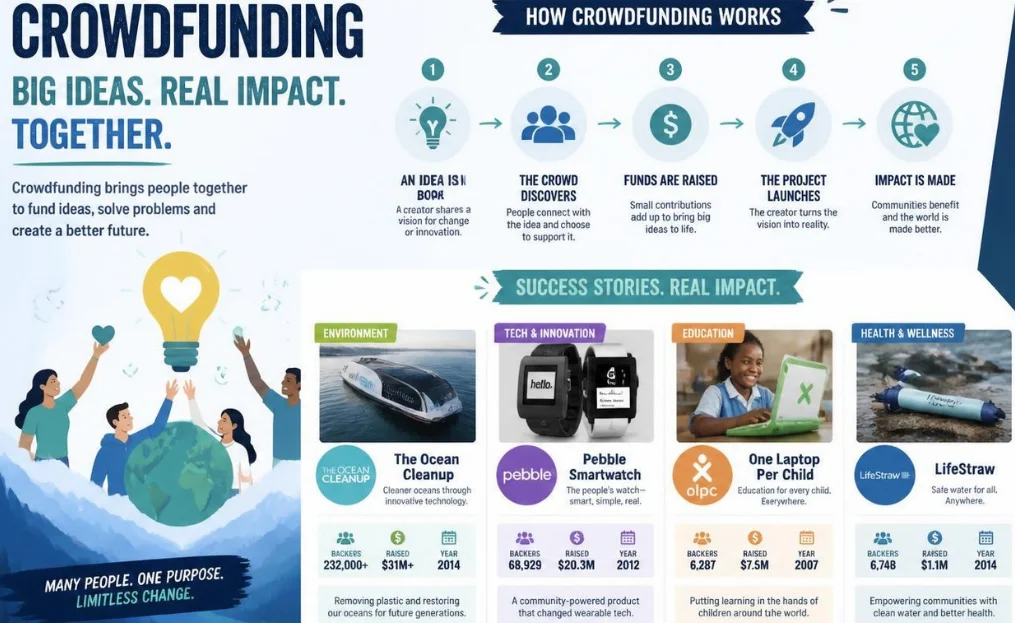
Crowdfunding gives individuals, businesses, charities, and community groups a way to raise money from many people online. Instead of relying on one bank or investor, a campaign can collect smaller contributions from a wider audience. In the UK, the right approach depends on what you are funding and what supporters receive in return.
Direct answer: Crowdfunding is a way to raise money from many people, usually through an online platform. A campaign sets a funding goal, explains the idea, and invites contributions. Supporters may donate, receive rewards, lend money, or invest for shares, depending on the model used.
| Key point | What it means |
|---|---|
| Main purpose | Raise money from a large group of supporters |
| Common models | Donation, reward, equity, and loan-based |
| Typical users | Start-ups, charities, creators, communities, and growing businesses |
| Main advantage | Access to funding plus public validation |
| Main challenge | Campaigns need strong promotion and supporter trust |
| UK regulation | Financial-return models can fall under FCA regulation |
| Main risk | Funding, delivery, or investment outcomes are never guaranteed |
What Is Crowdfunding and Why Do People Use It?

The basic idea is simple: many people contribute relatively small amounts towards one funding goal. The UK Crowdfunding Association describes the model as raising finance directly from a large group rather than a few major funders. Online platforms make it possible to present the idea, collect payments, and communicate with supporters.
People use this funding route for different reasons. A founder might finance a new product, while a community could fund a local facility or event. Charities and individuals can also collect donations for causes where no financial return is expected.
For businesses, the appeal goes beyond cash. A campaign can test demand before a larger launch and create an early group of customers or advocates. Founders considering different routes into entrepreneurship may also find Wordify’s guide to business ownership in the UK useful.
How Crowdfunding Works in Practice
Most campaigns start with a defined goal, deadline, story, and explanation of how the money will be used. The organiser publishes this information on a suitable online platform and begins promoting the campaign. Supporters then contribute according to the rules of that platform.
Some platforms use an all-or-nothing structure. Under that model, the organiser receives the funds only after reaching the stated target. Other campaigns may allow the organiser to keep whatever amount has been raised.
The platform may charge fees for hosting, payments, administration, or successful fundraising. Costs differ between providers and funding models, so organisers should read the current fee schedule before launching. A lower headline fee does not always mean a lower final cost.
The Four Main Types
Although the basic concept stays similar, the relationship between the organiser and supporter changes considerably. Picking the wrong structure can create financial, legal, or fulfilment problems later. These are the four models UK users are most likely to encounter.
| Model | What supporters receive | Often suited to | Main consideration |
|---|---|---|---|
| Donation-based | No financial return | Charities, personal causes, communities | Needs a convincing cause |
| Reward-based | Product, perk, service, or recognition | Creators and product launches | Rewards must be delivered |
| Equity-based | Shares or ownership interest | Start-ups and growth companies | Investors can lose their money |
| Loan-based | Repayment, usually with interest | Businesses and borrowers | Repayments create an obligation |
Donation-Based Funding
Donation campaigns ask people to give because they support a person, project, organisation, or cause. Donors normally receive no financial return from their contribution. This makes the model common among charities, community projects, emergencies, and social initiatives.
A strong emotional or community connection can matter more than a polished commercial proposition. Donors still expect clarity about where their money will go and whether the campaign is genuine. Clear updates can help retain trust after money has been collected.
Reward-Based Funding
Reward campaigns give supporters something non-financial in return for their contribution. The reward might be an early product, discounted service, event ticket, acknowledgement, or limited edition item. This approach can work well when a new product has a clear audience.
The main challenge arrives after the campaign succeeds. Organisers must manufacture, source, package, or deliver whatever they promised. Shipping costs and production delays can quickly reduce the amount left for the project itself.
A credible campaign also needs a page that explains the proposition clearly. Businesses preparing their online presence can compare options in Wordify’s guide to small business website design. A professional site can support trust when potential backers research the organisation before contributing.
Equity-Based Funding
Equity funding allows people to invest money in exchange for shares or another ownership interest. It is mainly used by start-ups and growth businesses that want to raise capital from multiple investors. Unlike a reward campaign, supporters are investing because they hope the company increases in value.
The Financial Conduct Authority regulates investment-based platforms operating within its remit in the UK. Investors should understand that early-stage companies can fail and shares may be difficult to sell. A successful fundraising round does not guarantee a profitable investment.
Businesses considering this route must also think about valuation, shareholder rights, documentation, and future financing. Giving away equity can reduce a founder’s ownership percentage for years. Professional legal and financial advice may therefore be sensible before accepting investment.
Loan-Based Funding
Loan-based or peer-to-peer funding connects borrowers with people willing to lend money. The borrower normally repays the capital over an agreed period, often with interest. This makes the structure different from equity because the lender does not usually gain ownership.
Repayment commitments can put pressure on cash flow if revenue falls below expectations. Companies should compare the full borrowing cost with other finance before accepting an offer. Wordify’s guide to bridge loan financial planning provides more context on assessing short-term borrowing commitments.
Benefits for UK Businesses and Project Owners
One major benefit is access. A good campaign can reach customers and supporters beyond the organiser’s immediate personal network. It can also reduce dependence on one lender or investor.
Public backing can provide another useful signal. If hundreds of people are prepared to support an idea before launch, that demand can help validate the concept. Feedback from early supporters may also reveal pricing, product, or messaging problems.
Campaigns can create publicity at the same time. Supporters often share projects they care about with friends or colleagues. That attention can build a community around the idea before the funded work is complete.
Risks You Should Understand First
Raising money from a crowd is not guaranteed to be easier than applying for traditional finance. Campaigns still need planning, persuasive communication, realistic numbers, and regular promotion. A weak launch can struggle even when the underlying idea is sound.
Reward campaigns carry fulfilment risk. Costs can rise after pledges are collected, while manufacturing or shipping can take longer than expected. Organisers should build a buffer into their target rather than assuming every pound raised is available for development.
Financial-return models create different risks. The FCA warns that investment and loan-based opportunities can be high risk, and investors may lose some or all of their money. Certain crowdfunded investments also do not receive Financial Services Compensation Scheme protection.
UK Regulation and Investor Protection
UK rules depend on the type of campaign and what supporters receive. Donation and reward campaigns generally do not involve an investment return, while investment and loan models can fall within FCA regulation. The exact position can also depend on how the offer is structured.
Anyone considering an investment platform should check the provider through the FCA Firm Checker. Authorisation does not remove investment risk or guarantee that a project will succeed. It does help users confirm whether a firm has the permissions it claims.
Organisers should also consider tax, company law, consumer obligations, data protection, and advertising requirements where relevant. These issues can vary by campaign structure and circumstance. Specialist advice is sensible when substantial money or company shares are involved.
How to Improve Your Chances of Reaching the Target
Successful campaigns rarely begin on launch day. Organisers should build an audience, prepare campaign assets, calculate costs, and line up early supporters beforehand. Early momentum can give later visitors more confidence in the project.
Before launching, focus on these practical steps:
- Set a funding target based on real costs, fees, tax, and contingency.
- Explain exactly what the money will fund.
- Use clear images, examples, or video where they improve understanding.
- Prepare an email and social media promotion plan.
- Ask existing supporters to contribute early.
- Keep rewards realistic and affordable to fulfil.
- Publish updates during and after the campaign.
- Check regulatory requirements before offering financial returns.
The campaign page should answer objections before people have to ask them. Explain who is behind the project, what happens if delays occur, and when supporters should expect results. Specific information builds more confidence than broad promises.
Is This Funding Route Right for You?
This approach works best when an idea has a clear audience that can understand its value quickly. It can be especially useful for consumer products, creative projects, communities, social causes, and companies with engaged followers. A campaign without an audience may require substantial marketing before it gains traction.
Traditional finance may suit some situations better. A profitable business might prefer a loan if its owners do not want to sell shares. A founder with predictable cash flow may also find private investment or conventional borrowing less demanding than a public campaign.
Think about what you are prepared to give in return for the money. That could mean rewards, interest payments, company ownership, or ongoing communication with a large supporter base. The cheapest-looking option is not always the best long-term choice.
Plan the Campaign Before You Publish It
A good campaign combines a suitable funding model with realistic costs, a credible story, and an audience willing to act. Decide what supporters receive, calculate what delivery will cost, and check the rules that apply before launch. Those decisions are easier to fix before people start contributing.
If the numbers and responsibilities still make sense, build the campaign around clear evidence rather than hype. Show people what their money will achieve and what happens next. That gives a promising idea a much stronger foundation for attracting support.Plan the Campaign Before You Publish It
A good campaign combines a suitable funding model with realistic costs, a credible story, and an audience willing to act. Decide what supporters receive, calculate what delivery will cost, and check the rules that apply before launch. Those decisions are easier to fix before people start contributing.
If the numbers and responsibilities still make sense, build the campaign around clear evidence rather than hype. Show people what their money will achieve and what happens next. That gives a promising idea a much stronger foundation for attracting support.
Frequently Asked Questions
Is crowdfunding regulated in the UK?
Some forms are regulated, while others are not regulated as investment activities. The FCA oversees relevant investment-based and loan-based activity, while donation and reward campaigns work differently. You should check the platform and the structure of the offer before committing money.
Do you have to pay back money raised from a campaign?
It depends on the model used. Donations normally do not require repayment, while rewards create an obligation to deliver the promised benefit. Loan funding requires repayment, and equity funding gives investors an ownership interest instead.
Can a UK start-up use this method to raise money?
Yes, start-ups can use reward, equity, and other models when the structure fits their needs. A consumer start-up might test demand through pre-orders, while a growth company might offer shares. Preparation and an existing audience can make a major difference to the result.
What happens if the target is not reached?
The outcome depends on the platform’s funding rules. All-or-nothing campaigns normally return pledges when the target is missed, while flexible models may allow organisers to keep funds raised. Always check the platform terms before choosing a campaign structure.
Is money invested through these platforms protected?
Protection depends on the product and provider. The FCA states that loan-based and investment-based opportunities can involve substantial risk, including loss of capital. Investors should never assume that FSCS protection applies to a crowdfunded investment.