

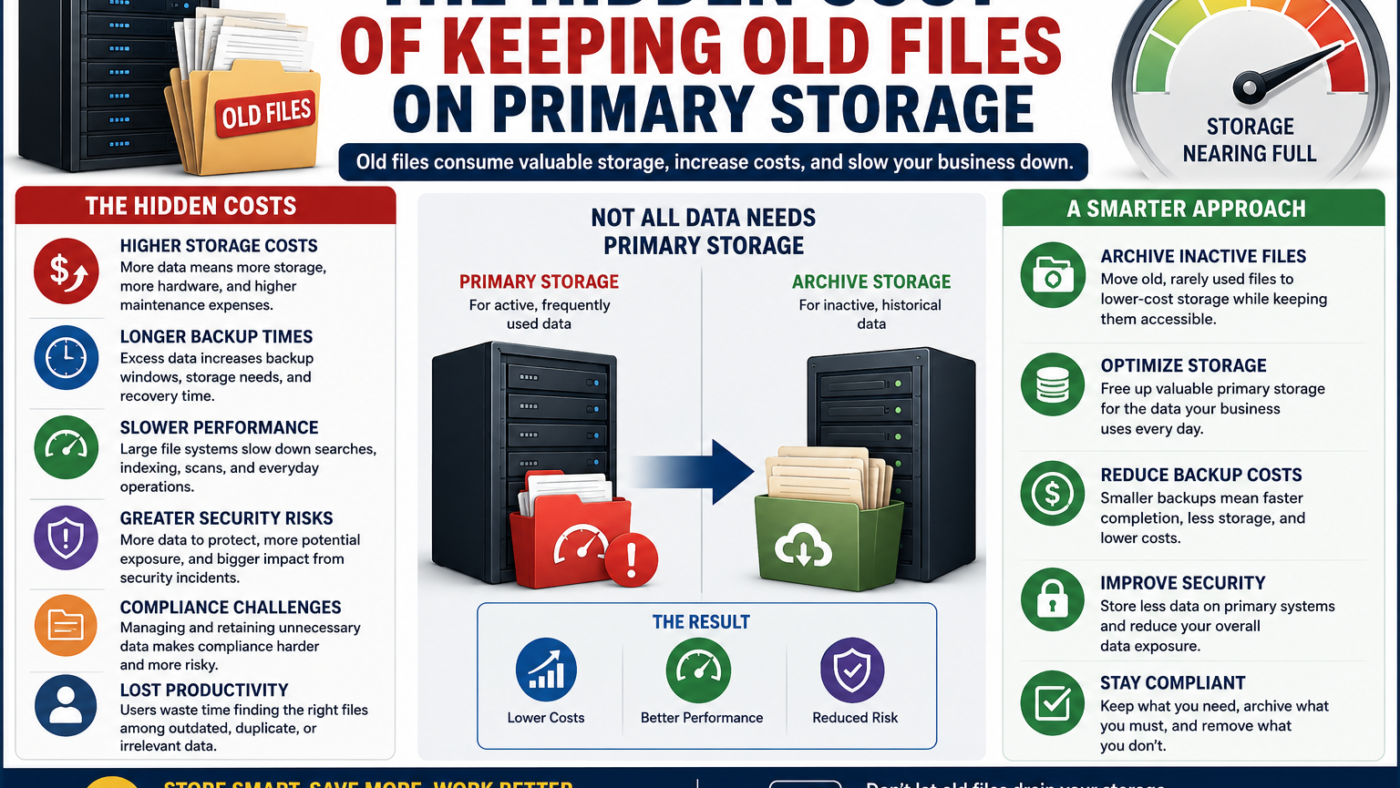
For many organisations, growing data volumes are simply accepted as part of doing business. Every department creates documents, every project generates new files, and every year adds another layer of digital information that needs to be stored somewhere. Elsewhere on the site: NAS vs Cloud Storage for Archived Files.
When storage capacity begins to decline, the most common solution is often straightforward: add more storage. While expanding infrastructure can provide immediate relief, it does not address the underlying reason storage continues to grow. In many cases, the real issue is not the amount of new data being created, but the amount of old data that remains on expensive primary storage long after it has stopped being actively used.
A completed project from several years ago, an outdated report, or a folder belonging to a former department may not seem significant individually. However, across a large organisation, thousands or millions of these files can consume substantial storage capacity. More importantly, they create additional costs that are not always immediately visible.
The true cost of keeping old files on primary storage extends beyond disk space. It affects backup efficiency, system performance, security management, compliance processes, and the overall ability of IT teams to manage information effectively.
Understanding these hidden costs allows organisations to make better decisions about where data should live throughout its lifecycle.
Not All Data Requires the Same Storage
One of the biggest challenges facing modern businesses is treating all data as if it has the same importance and access requirements.
Primary storage exists to support active business operations. It is designed for files and applications that employees need to access quickly and frequently. Current projects, operational documents, databases, and regularly updated information all benefit from being stored in high-performance environments.
However, not every file requires the same level of availability.
Many organisations accumulate years of historical information that remains stored alongside active business data. This may include completed projects, older versions of documents, archived customer records, previous reports, and other information that has value but is rarely accessed.
The problem is not necessarily that these files exist. In many cases, keeping historical information is important. The issue is that older files often remain on storage systems designed for everyday productivity, even when they no longer need that level of performance.
A more efficient approach is to recognise that data has a lifecycle. Some information is actively used today, while other information simply needs to be retained and accessible when required.
The Financial Impact of Storing Inactive Data
The most obvious consequence of keeping old files on primary storage is the need to continually increase capacity. As file servers grow, organisations often invest in additional disks, larger storage systems, and infrastructure upgrades.
However, the cost of storage expansion is not limited to purchasing more hardware.
Larger storage environments can also increase:
- Maintenance and support costs
- Energy consumption
- Data centre requirements
- Hardware replacement cycles
- Administrative workload
Over time, organisations can find themselves repeatedly investing in storage without solving the underlying problem of unmanaged data growth.
A file server that contains years of inactive information may be significantly larger than necessary. By identifying data that no longer requires primary storage performance, businesses can often extend the lifespan of existing infrastructure and delay expensive upgrades.
The goal is not simply reducing the amount of stored information. It is ensuring that expensive storage resources are being used for the information that benefits most from them.
Old Files Make Backup More Expensive and Complex
Backup systems are another area where the hidden cost of old files becomes clear.
A common misconception is that inactive files do not create problems because they are not changing. However, those files still need to be protected, managed, and included within backup strategies.
As file servers become larger, backup operations become more demanding. More data means longer backup windows, increased storage requirements, and potentially slower recovery processes.
For example, an organisation may have several years of historical project files stored on a file server. These files may only be accessed occasionally, but they continue to contribute to backup requirements.
This can lead to challenges such as:
- Longer backup completion times
- Increased backup repository growth
- More complex recovery planning
- Higher infrastructure requirements
By separating active data from inactive data, organisations can create more efficient backup strategies. Frequently used files can receive the fastest protection, while older information can be managed through appropriate archive processes.
The Performance Impact of Large File Systems
Storage capacity is not the only concern. Large volumes of inactive data can also affect the performance and manageability of file servers.
As file systems grow, everyday administrative tasks become more complicated. Activities such as indexing, searching, antivirus scanning, backup operations, and system maintenance all have to process increasing amounts of information.
Employees may also notice the impact. Large shared folders containing years of accumulated files can make it harder to locate important documents quickly. Users may encounter multiple versions of the same file, outdated information mixed with current documents, and increasingly complicated folder structures.
In many organisations, productivity issues caused by poor file organisation are difficult to measure because they appear as small delays rather than obvious failures. However, when hundreds or thousands of employees spend additional time searching for information, the cumulative impact can become significant.
A well-managed storage environment should make important information easier to find, not harder.
Old Data Creates Security and Compliance Challenges
Every file stored by an organisation represents a responsibility.
As businesses retain more information, they also increase the amount of data that must be secured, monitored, and managed. Older files can contain sensitive information such as customer records, financial documents, employee information, or confidential business material.
Keeping unnecessary information indefinitely increases the organisation’s overall data exposure.
From a security perspective, reducing unnecessary data accumulation helps limit potential risks. If information no longer serves a business purpose and is not required for legal or operational reasons, retaining it can create unnecessary obligations.
However, deleting everything is rarely the right answer.
Many organisations must retain information for regulatory, contractual, or historical reasons. The challenge is creating a structured approach that distinguishes between data that should be removed, data that should be archived, and data that should remain immediately accessible.
Why Keeping Everything on Primary Storage Is Inefficient
The idea of keeping every file immediately available may seem convenient, but it creates inefficiencies over time.
Primary storage is typically the most expensive storage tier because it provides the performance and accessibility required for active workloads. Using it as a permanent home for every file created by an organisation means valuable resources are being allocated inefficiently.
A better approach is to match storage location with business value.
Current information should remain on primary storage where employees can access it quickly. Older information that is still valuable can be moved to more appropriate storage environments while remaining available when required.
This type of tiered approach allows organisations to balance accessibility, performance, and cost.
The Role of File Archiving in Managing Data Growth
File archiving provides a structured way to manage older information without simply deleting it.
Rather than allowing inactive files to remain indefinitely on primary storage, organisations can identify data that is no longer actively used and move it to lower-cost storage environments while maintaining appropriate access.
A successful archiving strategy considers factors such as:
- How frequently files are accessed
- How long information needs to be retained
- Whether files are required for compliance reasons
- Which users or departments need access
The purpose of archiving is not to hide information away. Modern approaches focus on keeping important data available while ensuring that primary storage remains focused on active business needs.
As businesses look for ways to control long-term storage growth, solutions from providers such as MLtek demonstrate the wider shift towards more intelligent file management practices. Rather than simply adding more storage capacity, organisations are increasingly looking at technologies that help automate the movement and management of inactive files.
For example, platforms such as ArchiverFS reflect the growing demand for file archiving tools that allow businesses to reduce pressure on primary storage while maintaining access to historical information. The broader goal of these solutions is not just saving disk space, but creating a more organised and efficient approach to managing data throughout its lifecycle.
This allows organisations to maintain access to historical information while reducing unnecessary pressure on their main storage systems.
Building a More Effective Data Lifecycle Strategy
Managing storage effectively requires organisations to think about information throughout its entire lifecycle.
When a file is first created, it is usually active and requires fast access. Over time, however, its role may change. A project document that is accessed daily during development may become a reference document once the project is completed.
Without a lifecycle strategy, every file follows the same path: it remains on primary storage indefinitely.
A stronger approach involves regularly reviewing information and deciding what should happen next.
This may involve:
- Keeping active files on primary storage
- Moving older files to archive storage
- Applying retention policies
- Removing information that no longer has value
This approach prevents storage environments from becoming unmanaged collections of outdated information.
Practical Ways to Reduce the Impact of Old Files
Organisations looking to improve storage efficiency should begin with visibility. Before making changes, IT teams need to understand what data exists, where it is stored, and how it is being used.
Storage analysis can reveal:
- Which folders consume the most space
- How much data has not been accessed for years
- Where duplicate information exists
- Which departments generate the most growth
Once organisations understand their data, they can introduce clearer policies around storage usage and retention.
Employee education also plays an important role. Users should understand where files should be stored, how information should be organised, and why unnecessary duplication contributes to wider storage challenges.
Automation can further improve efficiency by helping organisations identify inactive files and apply consistent management rules over time.
Moving Beyond the “Buy More Storage” Approach
For many years, increasing storage capacity has been the default response to growing data volumes. However, this approach becomes increasingly expensive and difficult to manage as organisations scale.
The future of storage management is not simply about adding more space. It is about making better decisions about where information belongs.
Modern businesses are increasingly adopting strategies based on:
- Data classification
- Retention policies
- Storage tiering
- Automated lifecycle management
- Intelligent archiving
These methods allow organisations to maintain access to valuable information without allowing inactive data to overwhelm primary systems.
Conclusion: Managing Data Is More Effective Than Simply Storing It
Old files often appear harmless because they do not change and rarely cause immediate problems. However, over time, they create hidden costs across storage infrastructure, backups, security, compliance, and productivity.
The solution is not to remove valuable historical information or endlessly expand storage capacity. Instead, organisations need to take a more strategic approach to managing the information they already have.
By understanding data usage, applying sensible retention policies, and moving inactive files away from primary storage when appropriate, businesses can create more efficient and sustainable storage environments.
The most effective storage strategy is not one that stores the most data. It is one that ensures every piece of data is stored in the right place, for the right reason, at the right time.
Apart from that if you want to know about Samsung Galaxy Z Fold 6 Complete Guide: Design, Display, Performance, Camera, Battery, and Hidden Features then please visit our Tech Category.