

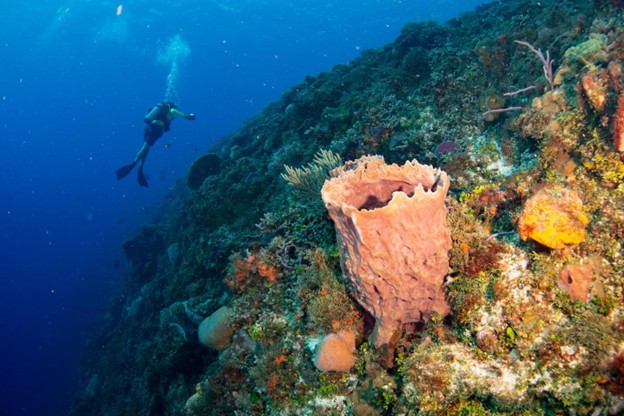
Sea sponges are ancient animals with no brain, heart or true organs that feed by pumping seawater through their porous bodies. They have existed for hundreds of millions of years, some can slowly crawl, a few species are carnivorous, and dolphins even use them as tools. Behind their still, rock-like appearance is one of the ocean’s strangest success stories.
Natural sea sponges belong to the phylum Porifera, meaning “pore bearer”. Though they can look like colourful rocks or corals, they are living animals that play an essential part in marine ecosystems. Below are the most surprising facts about how they eat, move, reproduce and interact with other sea life. For a deeper look at sponge anatomy, types and medical uses, see our companion guide, The Silent Architects of the Sea.
Sea Sponges at a Glance
| Fact | Detail |
|---|---|
| Kingdom | Animalia (animals, not plants) |
| Phylum | Porifera |
| Known species | More than 9,000 described |
| Habitat | Oceans worldwide, plus some freshwater lakes and rivers |
| Feeding | Mainly filter feeding; a few species are carnivorous |
| Organs | None: no brain, heart, gut or nerves |
| Movement | Larvae swim; some adults crawl very slowly |
| Size range | From small encrusting patches to barrel sponges big enough to sit in |
What Are Sea Sponges?
Sea sponges are multicellular animals that live attached to rocks, reefs, shipwrecks and the seabed. They come in a huge variety of shapes and colours, from small crusts to vases, tubes, fans and giant barrels. Despite their plant-like stillness, their bodies are packed with pores and channels that keep water flowing through them all the time.
15 Fascinating Facts About Sea Sponges
1. They are among the oldest animal lineages
Sponges are thought to sit near the base of the animal family tree, and evidence suggests they have been around for over 600 million years. That means they predate dinosaurs, fish and most other animal groups alive today.
2. They have no organs at all
A sponge has no brain, heart, lungs, stomach or nervous system. Instead, different cell types share the work of feeding, building the skeleton, transporting nutrients and reproducing.
3. They are expert filter feeders
Wondering What Do Sea Sponges Eat? Most feed on bacteria, plankton and organic debris. They draw water in through tiny pores called ostia, collar cells called choanocytes beat their flagella to keep it moving and trap food, and filtered water leaves through a larger opening called the osculum.
4. They pump huge volumes of water
Depending on size and species, a single sponge can filter a very large amount of water every day, potentially thousands of litres for large individuals. Across a reef, that adds up to a significant cleaning effect.
5. Some sponges are carnivores
A group of deep-sea sponges, the carnivorous sponges of the family Cladorhizidae, have largely abandoned filter feeding. They use tiny hook-like spicules to snag small crustaceans, then slowly engulf and digest them with their cells.
6. Adults can crawl, very slowly
Most adult sponges stay put, but research has shown some species can creep across surfaces by reorganising their cells, at a reported pace of roughly 1–4 mm per day. Scientists have also found tracks suggesting movement in some Arctic deep-sea sponges.
7. Their larvae are free swimmers
Sponge larvae use tiny hair-like cilia to swim or drift before settling on a suitable surface and transforming into a fixed adult. This is how sponges spread to new reefs and rocks.
8. Many are hermaphrodites
Many sponge species produce both eggs and sperm, often at different times to avoid fertilising themselves. Sperm released into the water is drawn into neighbouring sponges, where fertilisation happens.
9. They can rebuild themselves from cells
Sponges regenerate extremely well. In classic experiments, sponges broken down into individual cells were able to reaggregate and rebuild functioning bodies, a trait that interests researchers studying stem cells and tissue repair.
10. Some live for thousands of years
Giant barrel sponges on Caribbean reefs are estimated to live for many centuries, and some deep, cold-water glass sponges in Antarctica have been estimated at thousands of years old. These are estimates based on slow growth rates rather than exact ages.
11. They host partners inside their bodies
Many sponges house symbiotic bacteria, and some host photosynthetic algae or cyanobacteria. In certain species, these microbes make up a large share of the sponge’s tissue and help with nutrition and chemical defence.
12. They are apartment blocks for other animals
Shrimps, crabs, worms, brittle stars and small fish shelter inside sponge canals and on their surfaces. A single large sponge can host a surprising community of residents.
13. Dolphins use them as tools
In Shark Bay, Western Australia, some bottlenose dolphins carry marine sponges on their snouts while foraging on the seabed, apparently to protect themselves while hunting fish hidden in the sand. This behaviour is passed from mothers to calves, making it a well-known example of tool use in wild animals.
14. Glass sponges have skeletons like spun glass
Glass sponges build intricate skeletons from silica. Their structures are so efficient that engineers and materials scientists study them for ideas on strong, lightweight design.
15. Humans have harvested them for thousands of years
Soft bath sponges have been collected since ancient times. Sponge diving became a major industry on Greek islands such as Kalymnos and later in places like Tarpon Springs in Florida, where Greek divers brought their skills in the early twentieth century.
Ecological Importance
Sponges are vital to healthy seas. By filtering water, they help maintain clarity and quality and remove bacteria. On coral reefs they help recycle dissolved organic matter into food other animals can use, a process that supports reef food webs. They provide shelter for many species, serve as food for some turtles, fish and sea slugs, and in some places help bind loose reef material together.
Natural Sea Sponges in Everyday Life
The soft sponges sold for bathing, make-up, cleaning, painting and pottery are the cleaned, dried skeletons of certain demosponges. If you buy one, a few tips help:
- Choose suppliers who explain where their sponges come from and how they are harvested.
- Soak a new sponge in warm water before first use so it softens fully.
- Rinse after every use, squeeze it out and let it dry in a well-ventilated place.
- Avoid harsh bleach, which can weaken the fibres.
- Replace it if it starts to smell or crumble.
Common Misconceptions
- Sponges are not plants or corals. They are animals in their own phylum.
- Not all sponges are soft. Many have hard skeletons of silica or calcium carbonate.
- They are not inactive. They pump water constantly and some even move or hunt.
Final Thoughts on Sea Sponges
Natural sea sponges may look humble, but they are some of the most remarkable animals in the ocean. They filter seawater without a single organ, rebuild themselves from loose cells, shelter whole communities of animals and, in a few cases, hunt prey or crawl across the seabed. Next time you see a natural sponge, remember it is the skeleton of an animal lineage older than almost any other. If you enjoy discovering the natural world, read about the top 5 national parks for camping enthusiasts or browse our Daily Bites category.
FAQs
What do sea sponges eat?
Most sea sponges are filter feeders that eat bacteria, plankton and tiny organic particles drawn in with the water. A small number of deep-sea species are carnivorous and catch tiny crustaceans with hook-like spicules.
Can sea sponges move?
Their larvae swim freely before settling. Most adults stay fixed in place, but some species can crawl very slowly by rearranging their cells, at around a few millimetres per day.
Are sea sponges animals or plants?
Sea sponges are animals. They lack organs and tissues found in most other animals, but they feed on other organisms and develop from embryos, which places them firmly in the animal kingdom.
How do sea sponges reproduce?
They reproduce sexually, by releasing sperm that fertilises eggs in other sponges, and asexually, by budding or fragmenting. Many species are hermaphrodites that produce both eggs and sperm at different times.
Why are sea sponges important?
They filter large volumes of seawater, recycle nutrients on reefs and provide shelter for many other animals. Some sponge compounds have also led to useful medicines.