
In recent years, there has been a renewed appreciation for tactile, process-driven creativity. As digital images become increasingly disposable, many people are searching for ways to transform meaningful photographs into lasting physical objects. Among the most compelling interpretations of this shift is circular thread art — a technique that merges mathematical precision with hands-on craftsmanship.
Unlike traditional painting or printing, thread art does not rely on pigment to form an image. Instead, it uses tensioned lines stretched between carefully positioned anchor points. From a distance, these lines resolve into a recognizable portrait or motif. Up close, the viewer sees a complex network of intersections — a visible record of the construction process itself.
The Geometry Behind the Image
At the heart of modern circular string art lies algorithmic structure. The photograph is first analyzed digitally. By contrast levels, tonal transitions, and edge definitions are translated into a sequence of connections between evenly distributed points along a circular board. Each connection corresponds to a thread path.
The circular format plays a significant role in the final aesthetic. Because all anchor points are positioned along the perimeter, every thread spans across the center. This creates a dense web of intersecting lines that gradually build tonal depth. The more frequent threads cross a particular area, the darker that region appears.
This method produces a unique visual effect. Rather than simulating shading with color gradients, depth emerges through density. The image is not filled in; it is constructed through accumulation.
Why the Circular Format Matters
Circular compositions inherently suggest balance and harmony. Unlike rectangular frames, which guide the eye horizontally or vertically, a circle encourages rotational viewing. The absence of corners softens the visual impact while maintaining structural clarity.
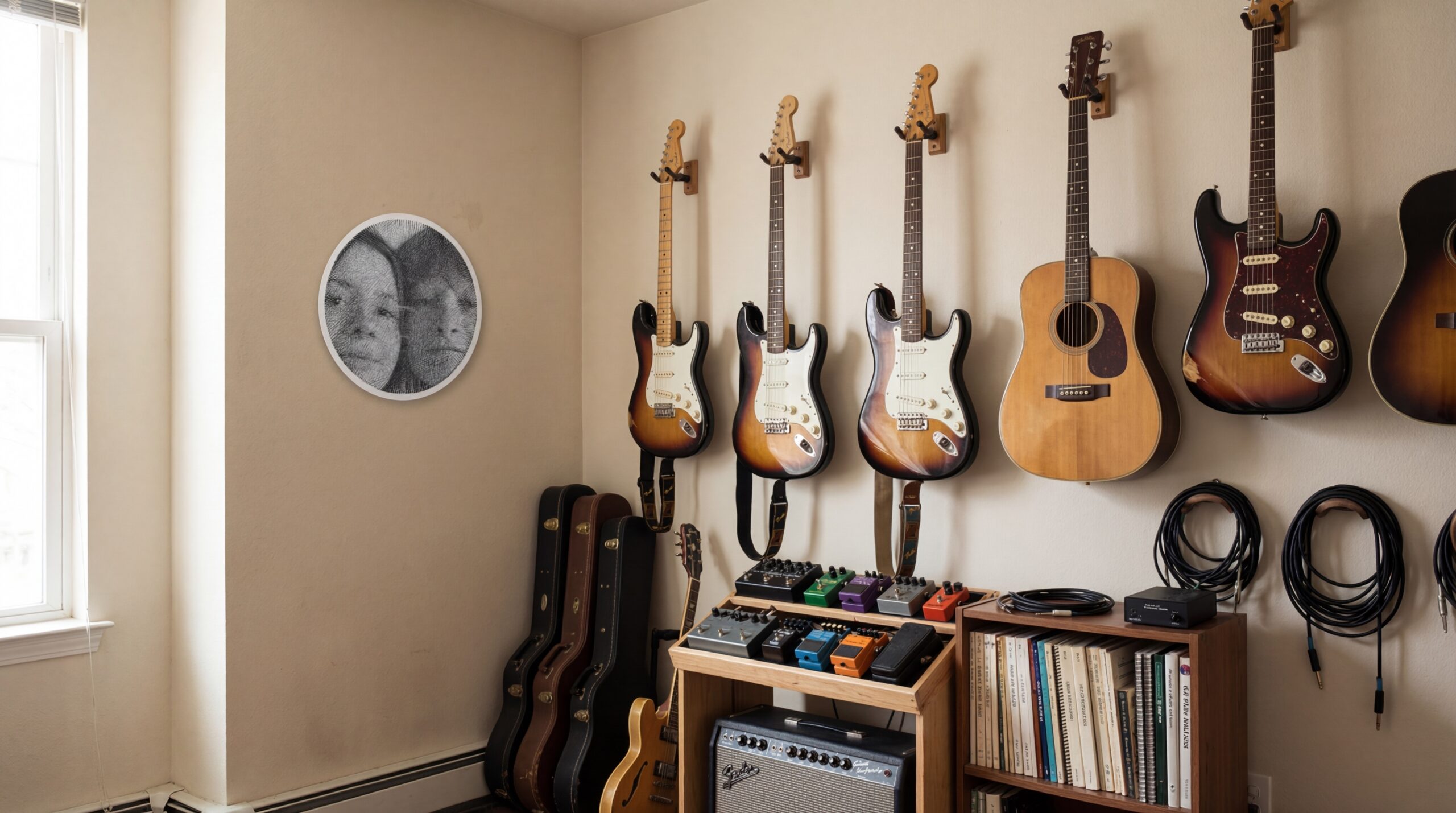
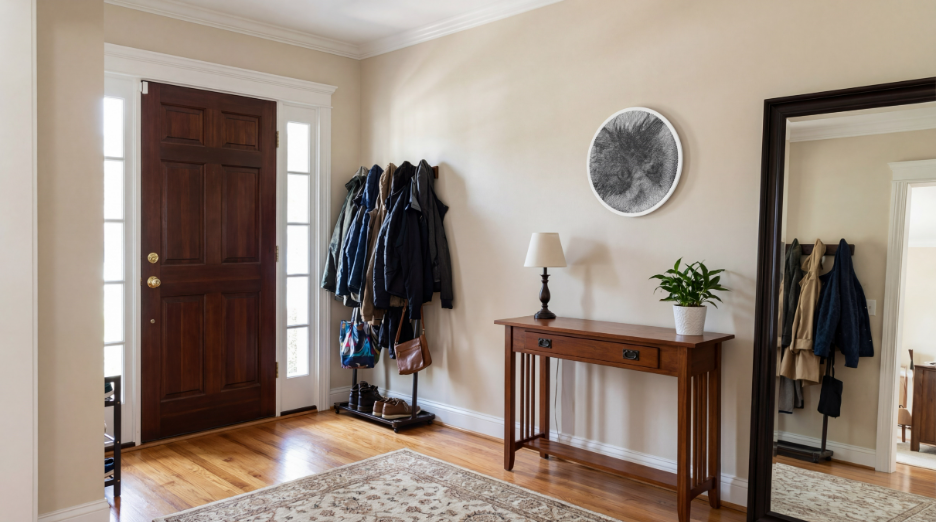
In interior spaces, circular thread art often feels sculptural rather than illustrative. Light interacts with the layered threads, casting subtle shadows that shift throughout the day. The artwork becomes dynamic, responding to its environment rather than remaining visually static.
This spatial quality distinguishes thread art from flat prints or canvas reproductions. It occupies space in a way that feels dimensional and architectural.
The Meditative Construction Process
While the visual outcome appears complex, the construction process follows a clear, logical sequence. Once the anchor points (usually small nails) are installed around the perimeter of the wooden board, the thread is guided from one numbered point to another.
Each movement is deliberate. There is no randomness involved. The maker simply follows the calculated order, gradually building the image layer by layer. This repetitive yet purposeful action often induces a state of focused calm.
Many participants describe the experience as meditative. The rhythm of winding thread, maintaining tension, and watching the image slowly emerge fosters concentration. Unlike spontaneous art forms, where decisions must constantly be made, structured thread art provides clarity: the path is predetermined, the goal defined.
In a world saturated with rapid decision-making and digital distractions, this clarity can be deeply satisfying.
Translating Personal Photographs
One of the most compelling aspects of circular thread art is its ability to reinterpret personal photographs. Portraits, pets, or symbolic moments can be transformed into minimalistic line compositions.
The translation process inevitably simplifies certain details. Instead of reproducing every color variation, the technique emphasizes contrast and silhouette. This reduction often strengthens emotional impact. By stripping away extraneous information, the image becomes more iconic.
The result is not a literal replica of the original photo, but a reinterpretation shaped by geometry and light.
An example of this approach can be seen in the Spatar Model Ring M, where the circular layout enhances clarity and tonal depth through increased thread intersections. The structured design ensures that even subtle facial features remain recognizable while maintaining a clean, graphic aesthetic.
Precision as an Artistic Principle
The success of circular thread art depends heavily on precision. Anchor placement must be evenly spaced. Thread of tension must remain consistent. Deviations in alignment can subtly alter contrast distribution and reduce sharpness.
Yet within this precision lies room for individuality. Different thread colors, wood finishes, or scale variations can significantly change the overall effect. A darker thread emphasizes contrast and intensity, while lighter tones create a softer impression.
This balance between control and expression defines the appeal of structured DIY projects. The system guarantees coherence; the material choices personalize the outcome.
Spatial Interaction and Light
Unlike printed photographs, thread-based artwork interacts actively with light. The layered lines create micro-shadows that enhance dimensionality. As daylight shifts, the perception of depth evolves.
From certain angles, the web of threads becomes more pronounced. From others, the portrait dominates. This duality gives circular string art a dynamic presence in contemporary interiors.
Because the design is inherently geometric, it pairs well with minimalist or modern décor. At the same time, handcrafted nature introduces warmth and texture.
Craft in the Age of Algorithms
Perhaps the most interesting aspect of modern thread art is the collaboration between algorithms and the human hand. The digital calculation ensures structural accuracy. Physical execution transforms that structure into a tangible object.
Rather than replacing craftsmanship, technology enhances it. Algorithms determine optimal thread paths; the maker provides patience and precision.
This hybrid model reflects a broader cultural movement: digital tools are increasingly used not to eliminate manual effort, but to refine it.
Beyond Decoration
Circular thread art is ultimately more than wall décor. It represents a deliberate creative process — one that values patience, repetition, and accuracy. The finished piece carries the memory of its construction within its visible structure.
Each line tells part of the story. Every intersection contributes to depth. The image is not simply displayed; it is built.
In an era defined by instant output, projects that require sustained attention offer a different kind of satisfaction. They remind us that complexity can emerge from simple, repeated actions — and that precision, when paired with intention, can transform an ordinary photograph into a sculptural expression of light and form.