

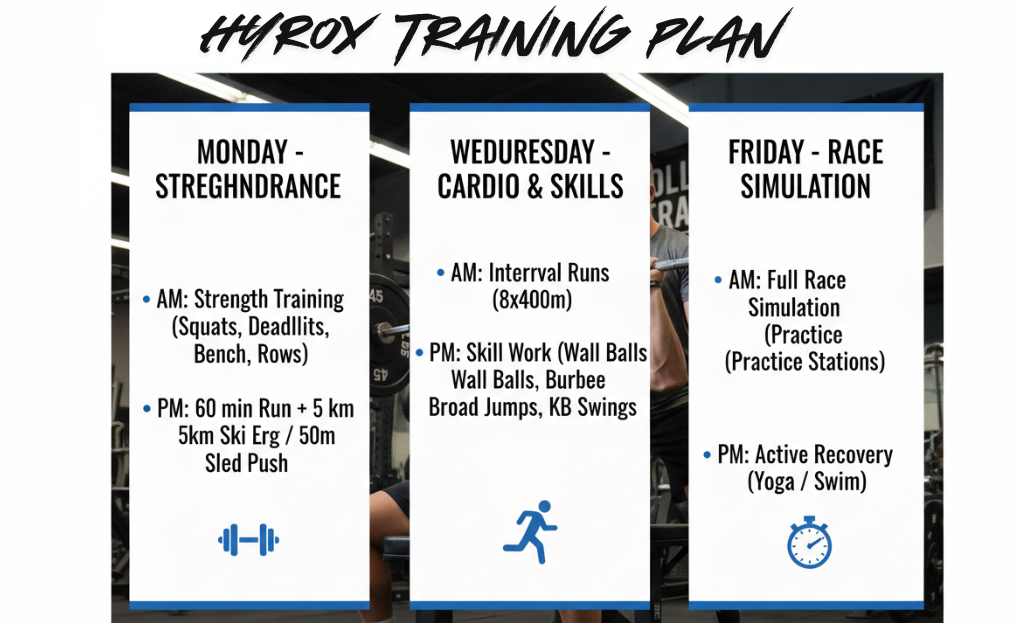
A good Hyrox training plan combines three things every week: running volume to handle 8 km of racing, strength work for the sleds, carries and lunges, and mixed “compromised running” sessions where you run straight after a station. Most people get the best results from 4–6 sessions a week over 10–12 weeks, building from an aerobic base to race simulations, with a lighter final week before the event.
The rest of this guide gives you the weekly structure, a 12-week progression, station-specific drills, pacing advice and the recovery habits that stop you breaking down halfway through the block.
What a Hyrox Race Actually Demands

Hyrox is a fitness race made up of eight 1 km runs, each followed by a functional workout station. The standard station order is SkiErg (1,000 m), sled push, sled pull, burpee broad jumps, rowing (1,000 m), farmer’s carry, sandbag lunges and wall balls. Loads and distances can differ slightly by division, so always check the current rulebook for your category before you set training weights.
What makes the race hard is not any single station. It is the accumulation. Your legs are already tired from the sled push when you start running again, your grip is fried after the farmer’s carry, and the wall balls arrive when your heart rate has been high for over an hour for most age-groupers. Your plan therefore needs to train three qualities at once:
- Aerobic endurance so you can run 8 km at a steady effort and recover between stations.
- Strength endurance in the legs, posterior chain, grip and shoulders for the sleds, carries, lunges and wall balls.
- Transition efficiency, meaning the ability to run well on legs that have just done heavy work.
| Component | What It Builds | Typical Sessions | Why It Matters on Race Day |
|---|---|---|---|
| Running | Aerobic base and pace control | Easy runs, tempo runs, intervals | Half the race is running; poor pacing costs the most time |
| Strength | Force for sleds, lunges and carries | Squats, deadlifts, lunges, presses, carries | Heavy stations feel manageable rather than maximal |
| Conditioning | Strength endurance under fatigue | Rowing, SkiErg, wall balls, burpees | Keeps output high late in the race |
| Simulation | Running on tired legs | Run plus station “bricks” | Teaches pacing and transitions |
| Mobility and recovery | Movement quality and adaptation | Mobility flows, sleep, deload weeks | Keeps you training consistently without injury |
Before You Start: Check Your Baseline
Spend the first week testing so you know where to aim. Useful baseline checks include a 5 km run time, a 1,000 m row, a 1,000 m SkiErg, and how many unbroken wall balls you can do at your race weight. If your gym has sleds, push and pull a moderate load over 25 m and note how it feels rather than chasing a time.
These numbers show your limiter. Someone with a quick 5 km but slow sled work needs more leg strength. A strong lifter who struggles to run 5 km needs more aerobic volume. A good Hyrox training plan spends extra time on the weakest link instead of repeating what you already do well.
Weekly Workout Structure
This template suits someone training five or six days a week. If you can only manage four, merge the conditioning circuit into the strength days and keep the long run and simulation session.
| Day | Session | Example Content | Main Goal |
|---|---|---|---|
| Monday | Lower-body strength + short intervals | Back squat, walking lunges, then 6 x 400 m | Leg strength and speed |
| Tuesday | Station conditioning | Sled push and pull intervals, rowing, wall balls | Strength endurance |
| Wednesday | Easy or steady run + core | 6–10 km at conversational pace, planks, Pallof press | Aerobic base |
| Thursday | Upper body and posterior chain | Deadlift, overhead press, pull-ups, farmer’s carry | Total strength and grip |
| Friday | Mixed circuit | Burpee broad jumps, kettlebell swings, SkiErg | Work capacity |
| Saturday | Simulation or brick workout | 1 km run + station, repeated 4–8 rounds | Race-specific fitness |
| Sunday | Active recovery | Mobility, light cycling or walking | Recovery |
Keep easy days genuinely easy. A common trap is turning every session into a hard one, which leaves you too tired to hit the quality sessions that drive progress.
A 12-Week Hyrox Training Plan Progression
Breaking the block into phases lets your body adapt in a logical order: build the engine and movement quality first, then add intensity, then make training look like the race.
Weeks 1–4: Base Phase
- Strength: 3 sets of 8–12 reps on squats, lunges, Romanian deadlifts, presses and rows, leaving 2–3 reps in reserve.
- Running: mostly easy runs, building total weekly distance gradually; one session of short strides or 400 m repeats.
- Stations: learn technique at light loads, especially sled posture, wall ball rhythm and burpee broad jump landing.
- Week 4: reduce volume by roughly a third to absorb the work.
Weeks 5–8: Build Phase
- Strength: increase load with 4 sets of 6–8 reps; add heavier carries and sandbag or weighted lunges.
- Running: add a weekly tempo run at a “comfortably hard” effort and longer intervals such as 4–6 x 1 km.
- Conditioning: station intervals with short rests, for example 5 rounds of 250 m row plus 20 wall balls.
- Bricks: start running 1 km straight after a station, two or three times per session.
- Week 8: lighter week again.
Weeks 9–12: Race-Specific Phase
- Strength: heavier, lower-rep work (3–6 reps) on main lifts with less total volume so legs stay fresh for running.
- Simulations: half and full race simulations, at least one full or near-full simulation around three weeks out.
- Pacing: rehearse your target 1 km split after every station.
- Final week: cut volume sharply, keep a few short efforts at race pace and prioritise sleep.
Structured Strength Programming

Strength in Hyrox is about producing force repeatedly, not lifting a one-rep max. Heavy sleds reward strong quads, glutes and a stiff, braced trunk, while the farmer’s carry and sled pull depend on grip and upper back.
- Lower body: back squats, front squats, walking lunges, step-ups.
- Posterior chain: deadlifts, Romanian deadlifts, hip thrusts, kettlebell swings.
- Pushing and pulling: overhead press, push-ups, pull-ups, bent-over rows, heavy rope or sled pulls.
- Grip: farmer’s carries, dead hangs, heavy holds at the top of a deadlift.
- Core: planks, Pallof presses, dead bugs and loaded carries for anti-rotation strength.
Progress by adding small amounts of weight or one or two reps each week while keeping technique clean. If running sessions start to suffer, trim accessory work before you cut a run.
Station-Specific Drills
Practising each station under fatigue is where a generic gym programme turns into a Hyrox plan. These drills are simple to fit into the conditioning days.
| Station | Key Technique Point | Drill to Use |
|---|---|---|
| SkiErg | Hinge at the hips and use the lats, not just the arms | 4 x 250 m at race effort, 1 minute rest |
| Sled push | Low body angle, arms locked, short fast steps | 6 x 12.5 m heavy push, walk back recovery |
| Sled pull | Sit back, walk the rope hand over hand, keep tension | 4 x 25 m pulls followed by 200 m run |
| Burpee broad jumps | Steady rhythm, land soft and step back into the next rep | 4 x 20 m, focusing on even pace |
| Rowing | Legs then body then arms; steady stroke rate | 3 x 500 m at target race pace |
| Farmer’s carry | Tall posture, quick steps, set grip before you lift | 4 x 50 m at or above race load |
| Sandbag lunges | Bag secure on shoulders, consistent knee touch | 4 x 25 m, then 400 m run |
| Wall balls | Full squat depth, hit the target, break into planned sets | EMOM of 10–15 reps for 8–10 minutes |
High-Intensity Conditioning Drills
Conditioning bridges strength and endurance. Interval-based sessions teach you to hold a high output while managing fatigue, which is exactly what the second half of a Hyrox race requires.
A practical example: run 800 m, do 20 wall balls, run 400 m, complete a 25 m sled push, then repeat three or four times. Another option is a 30-minute EMOM rotating rowing calories, burpee broad jumps, kettlebell swings and a short run. Keep rest periods short enough that your heart rate stays elevated, but long enough that technique holds up. Sloppy wall balls or sled pushes in training become slow, costly reps on race day.
Running Strategy and Pacing
Running makes up a large share of total race time, so even small pacing improvements add up across eight kilometres. Use four types of running in your week:
- Easy runs at a pace where you can talk in full sentences. These build the aerobic base that helps you recover between stations.
- Intervals such as 400 m or 1 km repeats to raise top-end speed and anaerobic capacity.
- Tempo runs of 15–30 minutes at a comfortably hard effort to lift your threshold.
- Brick runs straight after a station, which teach you to find your rhythm on heavy legs.
On race day, start the first run slower than you think you need to. Adrenaline makes early kilometres feel easy, and going out too fast is one of the most common reasons people fade by the lunges. Aim for even splits; your first 1 km and your last should ideally be within a few seconds of each other once you subtract the time spent in the Roxzone between stations.
Simulation Workouts
Simulation sessions bring all of the components together. They show whether your pacing plan works and where you lose time. A useful half-race simulation might look like this:
- 1 km run, then 1,000 m SkiErg
- 1 km run, then sled push
- 1 km run, then rowing 1,000 m
- 1 km run, then 100 wall balls
Alternate between the first-half and second-half stations across different weeks. Record each split so you can compare. Do a full simulation no closer than about two to three weeks before the race to give yourself time to recover.
Mobility Work and Injury Prevention
Mobility work does not need to be long to be useful. Ten minutes before training and a short session on your recovery day cover most needs. Prioritise the areas Hyrox loads hardest:
- Hips: hip flexor stretches, 90/90 transitions and deep squat holds for lunges and wall balls.
- Ankles: knee-to-wall drills, helpful for sled pushing and squat depth.
- Thoracic spine and shoulders: open books and band pull-aparts for SkiErg and wall ball overhead work.
- Calves and feet: easy calf raises and foam rolling, given the amount of running involved.
Increase running volume gradually and listen to niggles early. A sore Achilles or knee that is ignored for a week often becomes an injury that costs a month. If pain persists or worsens, see a physiotherapist or sports medicine professional rather than training through it.
Performance Tracking
Tracking turns guesswork into adjustments. Keep a simple log of:
- Running pace per kilometre on easy, tempo and brick runs
- Station times in simulations, including sled push and pull
- Key lift numbers for squat, deadlift and press
- Resting heart rate or heart rate variability if you use a wearable
- Sleep, soreness and general energy levels
If your easy-run pace is improving and station times are dropping, the plan is working. If resting heart rate climbs, sleep worsens and sessions feel harder at the same pace for more than a few days, take an extra rest day or a lighter week.
Nutrition and Recovery
Training this mix of strength and endurance needs fuel. Base most meals around carbohydrate sources such as oats, rice, potatoes and bread for energy, a palm-sized portion of protein to support muscle repair, plenty of vegetables, and some healthy fats. Eat a carbohydrate and protein meal or snack within a couple of hours after hard sessions to help with recovery.
Hydration matters, especially during long simulations. Drink regularly through the day and consider electrolytes for sessions longer than an hour or in hot conditions. Sleep is the most underrated recovery tool: aim for a consistent seven to nine hours. Deload weeks every three or four weeks give your body a chance to adapt and reduce injury risk. If you have a medical condition or specific dietary needs, a registered dietitian can tailor a plan to you.
Common Mistakes to Avoid

- Skipping running sessions because the gym work feels more “Hyrox”. Running is half the race.
- Too much strength volume late in the block, leaving legs heavy for running.
- Never training compromised running, then being shocked at how slow the first post-sled kilometre feels.
- Going out too fast on the first run and paying for it from the farmer’s carry onwards.
- Skipping deloads and sleep, which slows progress more than any missed workout.
- Practising stations with poor technique, particularly wall balls that do not reach the target or squat depth.
Race-Day Strategy and Mental Preparation
Break the race into eight runs and eight stations rather than thinking about the whole thing. Before each station, decide how you will break it up, such as wall balls in sets of 15–20 with short planned breaks. Control your breathing as you enter the Roxzone, and use the first 200 m of each run to settle into rhythm rather than sprinting off.
Eat a familiar meal a few hours before your start time, warm up with easy jogging and a few short efforts, and do not try new shoes, gels or kit on race day. Visualise your splits and transitions in the days leading up to the event so the plan feels automatic.
Bottom Line on Your Hyrox Training Plan
The most effective Hyrox training plan is balanced and progressive: build an aerobic base and solid strength first, add intensity and bricks in the middle weeks, then sharpen with simulations and a proper taper. Track your splits, fix your weakest station, protect your easy days and sleep, and you will arrive on the start line ready to race the whole distance rather than survive it. For more workouts and training guides, browse our Fitness section.
FAQs
How many weeks should a Hyrox training plan be?
Most people do well with 10–12 weeks of structured preparation if they already have a reasonable fitness base. Complete beginners may benefit from 16 weeks or more so they can build running volume and learn station technique gradually. Shorter plans can work for experienced athletes who already run and lift regularly.
How many days a week should I train for Hyrox?
Four to six sessions a week covers most needs. A good split is two strength sessions, two or three running sessions and one or two conditioning or simulation workouts. Fewer, well-recovered sessions beat daily training that leaves you constantly tired.
Should beginners use heavy sled loads immediately?
No. Start with manageable loads to learn body position and footwork, then build towards race weight over several weeks. Gradual progression reduces strain on the lower back and knees and leads to better long-term strength.
How important is grip strength in Hyrox?
Grip affects the farmer’s carry, sled pull and SkiErg, and a failing grip forces extra breaks. Add farmer’s carries, dead hangs and heavy holds once or twice a week. Chalk use and gloves depend on event rules, so check what is allowed beforehand.
What is the biggest mistake people make when preparing for Hyrox?
Focusing heavily on strength while neglecting running endurance is the most common error. Since the race alternates running with stations, poor aerobic fitness costs time on every kilometre. Balanced training and regular brick sessions fix this.
Do I need to do a full Hyrox simulation before race day?
It is helpful but not essential. One full or near-full simulation around two to three weeks out shows how your pacing holds up. Half simulations are enough most weeks and are easier to recover from.