

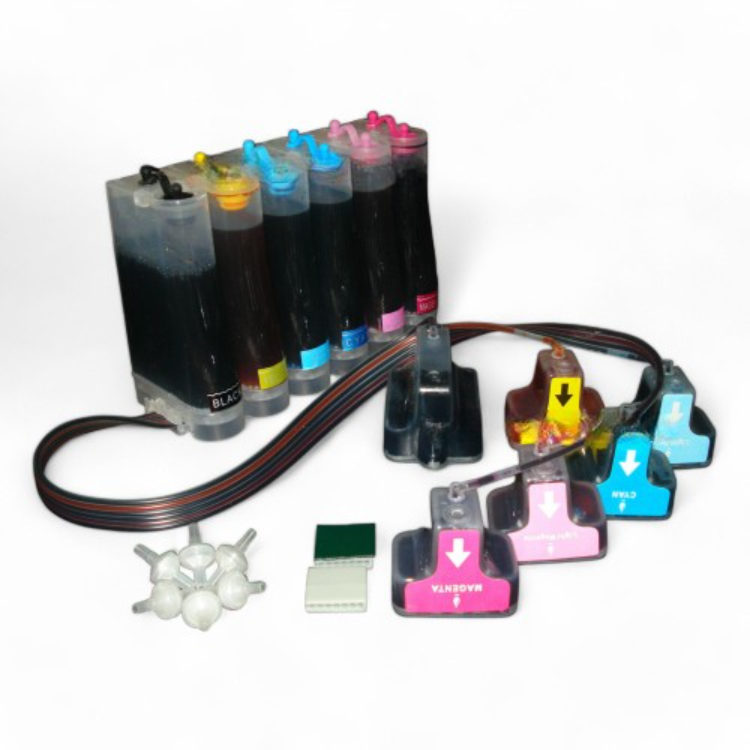
A continuous ink supply system (CISS) has long been one of the best ways to make printing significantly more economical, convenient, and environmentally friendly. It can reduce consumable costs several times over, support uninterrupted printing of large volumes of documents and photographs, and minimize the need for frequent cartridge replacement. However, these advantages can only be achieved by choosing the right system.
The modern market offers dozens of CISS kits that differ in design, material quality, compatibility, and technological solutions. At first glance, many systems may look identical, but in practice, the difference between a high-quality product and a cheap alternative can be enormous. The right choice affects not only print quality but also printhead lifespan, printer stability, and overall long-term savings.
Why Should You Avoid Buying the Cheapest CISS?
Many users who decide to install a CISS for the first time focus primarily on price. This is understandable, as the main advantage of such a system is cost savings. However, an excessively cheap kit often means low-quality materials, an imprecise design, or outdated technology.
Low-quality plastic may deform when exposed to heat, lose its airtightness, or react chemically with ink components. As a result, this may lead to inaccurate color reproduction, sediment formation, air entering the system, or even damage to the printhead.
In addition, inexpensive kits are often equipped with outdated chips that stop working after several printing cycles or do not support newer printer firmware versions.
For this reason, when choosing a CISS, you should evaluate not only its price but also its technical specifications, giving preference to modern, efficient, and cost-effective PRINTOUT systems: https://printout24.com/
Compatibility with the Printer Model
The most important selection criterion is the system’s full compatibility with a specific printer model.
There is no universal CISS that works equally well with every device. Each manufacturer uses its own carriage, printhead, cartridge, and software design.
Before purchasing a system, make sure that it is intended specifically for your printer model.
Reputable manufacturers always provide a complete list of compatible models.
If a kit is marketed as “universal,” it should be approached with great caution.
Quality of the Ink Tanks
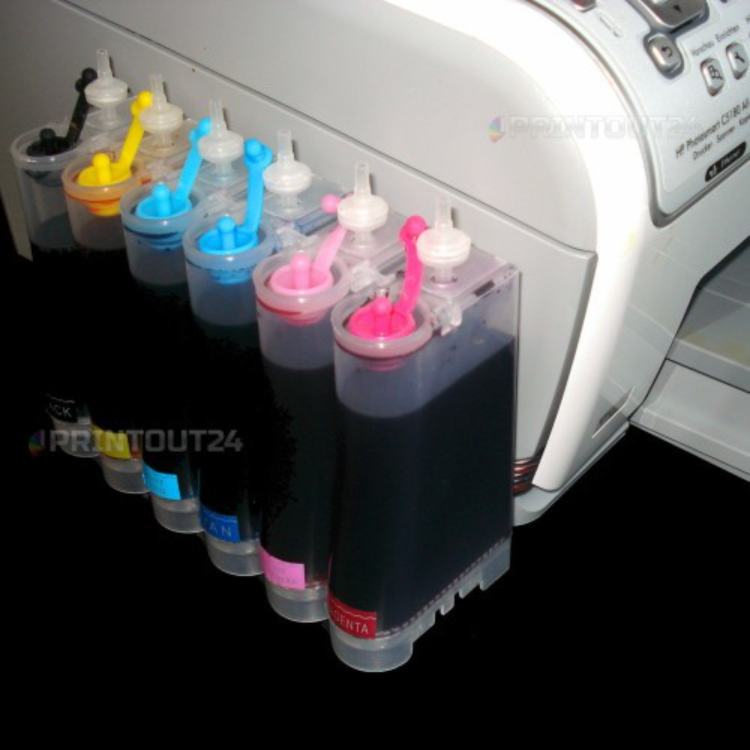
The ink tanks are the foundation of the entire system.
The best models are made from transparent polyethylene or high-quality polypropylene.
These materials offer several important advantages:
- They do not react chemically with the ink.
- They retain their properties for many years.
- They make it easy to monitor ink levels.
- They withstand temperature fluctuations effectively.
Transparent tanks also make maintenance significantly easier because the user can always see how much ink remains for each color.
Tubing Material
The tubing is one of the most heavily loaded parts of the system.
It moves continuously together with the printer carriage.
Reputable manufacturers use multilayer silicone or specialized polymers that:
- remain flexible even after many years of use;
- do not kink;
- do not crack;
- do not lose their transparency;
- maintain a stable ink flow.
Cheap tubing quickly hardens, bends, and may cause pressure fluctuations within the system.
Cartridge Quality
Modern CISS kits use refillable cartridges.
They must:
- precisely match the dimensions of the original cartridges;
- have high-quality seals;
- maintain airtight connections;
- support stable pressure levels.
Even a slight dimensional discrepancy can result in incorrect installation or air entering the system.
New-Generation Auto-Reset Chips
Electronic chips deserve particular attention.
Modern, high-quality CISS kits are almost always equipped with Auto Reset Chips.
Their main advantages include:
- Automatic restoration of the displayed ink level.
- No need to use software-based reset tools.
- Support for modern printer models.
- Fast printer recognition after refilling.
- Minimal user involvement.
Older chip generations often required manual resetting or even replacement after several operating cycles.
Ink Quality Is Crucial
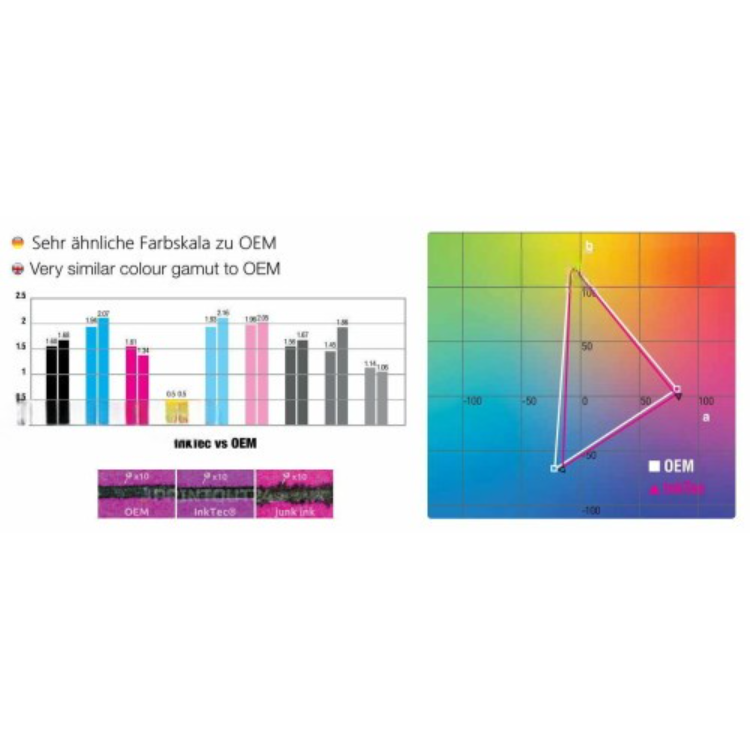
Even the best system will not deliver good results when used with low-quality ink.
Many users mistakenly believe that all inks are essentially the same.
In reality, there can be major differences between them.
High-quality ink:
- has optimal viscosity;
- does not clog the nozzles;
- provides accurate color reproduction;
- dries quickly;
- resists fading when exposed to sunlight;
- offers a high level of compatibility with specific printer models.
Cheap universal ink may contain impurities that clog the printhead, reduce color accuracy, and shorten the printer’s service life.
Therefore, it is best to use ink that has been tested by the CISS manufacturer specifically for your printer model.
Is Certification Important?
Absolutely.
Reliable manufacturers operate in accordance with international quality standards.
For example, production certified under the ISO 9001 standard indicates that all stages of the manufacturing process are properly controlled.
You should also pay attention to:
- the manufacturer’s warranty;
- technical support;
- the availability of installation instructions;
- packaging quality;
- the contents of the kit.
Kit Contents
A reliable kit usually contains everything required for installation and continued use.
A standard kit includes:
- ink tanks;
- refillable cartridges;
- tubing;
- mounting components;
- air filters;
- plugs;
- a refilling kit;
- installation instructions;
- auto-reset chips.
If some of these components are missing, it may indicate that the system belongs to the budget segment.
How Can You Tell a High-Quality System from a Cheap Counterfeit?
At first glance, the difference may not be obvious, but it quickly becomes apparent during operation.
A high-quality system is characterized by:
- strong, transparent plastic without an unusual odor;
- evenly molded components without burrs or rough edges;
- flexible silicone tubing;
- airtight connections;
- modern Auto Reset Chips;
- full compatibility with specific printer models;
- high-quality factory packaging;
- a manufacturer’s warranty.
Cheap alternatives can often be identified by:
- uneven molding;
- thin plastic;
- rigid tubing;
- a lack of manufacturer information;
- questionable universal ink;
- outdated chips;
- incomplete kit contents.
Why Should You Not Cut Costs on a CISS?
At first glance, all continuous ink supply systems may appear to be the same. However, saving money on the kit itself often leads to significantly higher expenses in the future. Unstable ink delivery, incorrect chip operation, leaking tanks, or low-quality materials may result in expensive printer repairs or even the need to replace the printer entirely.
A high-quality CISS, by contrast, can provide years of stable operation, maintain a consistent ink supply, preserve high print quality, and allow users to take full advantage of the technology’s main benefit: substantial savings on consumables without causing damage to the equipment.