


Criminal Minds Season 16, released as Criminal Minds: Evolution, marks a bold and modern reinvention of the long-running crime series, shifting it from a traditional case-of-the-week procedural into a darker, more serialized, and emotionally intense narrative built for the streaming era. The season follows the FBI’s Behavioral Analysis Unit as it confronts a disturbing and highly coordinated criminal network.
As the BAU, led by Emily Prentiss and supported by veteran agents like David Rossi, JJ Jareau, Luke Alvez, and Penelope Garcia, works to uncover this expanding web of crimes, they are forced to adapt to new threats shaped by modern technology, including encrypted communication, dark web recruitment, and advanced digital manipulation tactics.
At the same time, the season places strong emphasis on the emotional and psychological toll of their work, revealing how years of exposure to violence have left each member dealing with trauma, ethical conflict, and personal strain. It has a cinematic tone, deeper character arcs, and a continuous storytelling structure.
| Section | Summary |
| Platform & Format | Released on Paramount+, featuring longer episodes, continuous storytelling, and a binge-friendly structure. |
| Main Focus | The BAU investigates a connected network of serial killers controlled by a hidden mastermind using modern digital crime methods. |
| Main Team | Led by Emily Prentiss, supported by Rossi, JJ, Alvez, and Garcia, each playing specialized investigative roles. |
| Story Structure | A single overarching case with interconnected episodes revealing victims, suspects, and clues about a criminal network. |
| Criminal Element | Multiple offenders operate under one system using psychological manipulation, encrypted communication, and dark web activity. |
| Key Themes | Psychological warfare, cybercrime, moral conflict, leadership pressure, emotional trauma, and ethical boundaries in justice. |
| Villain Concept | Shift from single killers to coordinated criminals controlled by a hidden mastermind. |
| Production Style | Dark, cinematic visuals with realistic crime scenes and slower, suspense-driven storytelling. |
| Character Focus | Strong emphasis on emotional depth, trauma, burnout, and evolving relationships within the BAU. |
| Audience Response | Praised for maturity and performances, but noted for slower pacing and less episodic variety. |
| Importance | Revives and modernizes the franchise, shifting it into a serialized, streaming-era crime drama. |
Criminal Minds Season 16

Criminal Minds Season 16 (released as Criminal Minds: Evolution) marks a powerful reinvention of the iconic FBI Behavioral Analysis Unit, bringing the franchise into a darker, more serialized, and emotionally complex streaming era. Unlike the original procedural format, this season follows a continuous narrative centered on a coordinated criminal network.
The BAU, led by Emily Prentiss and supported by returning agents such as David Rossi, JJ Jareau, Luke Alvez, and Penelope Garcia, is forced to adapt to a new kind of threat shaped by the digital age, including encrypted communication, dark web recruitment, and psychological manipulation.
Season 16 places strong emphasis on character depth, showing how years of exposure to violent crime have left the team emotionally strained, ethically conflicted, and personally affected by trauma. With its cinematic tone, longer episode arcs, and intense focus on profiling and modern cyber-enabled crime.
Series Background and Evolution
Evolution Over Time
Over its original run, the series evolved in several key ways:
- Shifted from episodic cases to emotional character arcs
- Introduced long-term villains and recurring threats
- Expanded focus on team relationships and trauma
- Developed deeper psychological storytelling
Transition to Streaming Era
Season 16 represents a full transition into streaming storytelling:
- Longer episode runtimes
- Serialized narrative structure
- Darker tone and mature themes
- Focus on continuity rather than isolated cases
Release Information

Criminal Minds Season 16, released under the title Criminal Minds: Evolution, marks a reboot-style continuation of the original series with a clear shift toward modern streaming storytelling. It premiered on Paramount+ during the 2022–2023 release period and was designed specifically for a digital audience.
Unlike the earlier CBS format, which focused on standalone episodic cases, this season adopts a serialized multi-episode arc structure that allows the narrative to build continuously across the season. The overall tone is notably darker, more cinematic, and psychologically driven, reflecting the deeper and more mature direction of the series.
This structural shift also makes the season more suitable for binge-watching, as each episode directly connects to the next, creating a continuous and immersive storytelling experience.
Main Cast and Returning Characters
| Character | Actor | Role Description |
| Emily Prentiss (Unit Chief) | Paget Brewster | Prentiss leads the BAU with strong authority and emotional intelligence. She manages high-pressure leadership responsibilities while balancing FBI political demands with critical operational decisions in dangerous investigations. |
| David Rossi | Joe Mantegna | Rossi is the veteran profiler of the team, bringing decades of experience in criminal psychology. However, he also struggles with emotional exhaustion and trauma from past cases, which continues to affect his outlook. |
| Jennifer “JJ” Jareau | A.J. Cook | JJ serves as both a profiler and a communications specialist. Her emotional intelligence and field experience make her highly effective in understanding both victims and suspects during investigations. |
| Luke Alvez | Adam Rodriguez | Alvez is a tactical field agent specializing in tracking, pursuit, and suspect apprehension. In Season 16, his role becomes more action-oriented and physically demanding. |
| Penelope Garcia | Kirsten Vangsness | Garcia is the BAU’s cyber intelligence expert, responsible for surveillance, digital tracking, and data analysis. Her importance increases significantly as the team deals with modern digital-age crime. |
Central Narrative Structure

Season 16 introduces a major shift by focusing on a single overarching criminal network instead of independent weekly cases.
This structure includes:
- A coordinated group of serial killers
- A hidden mastermind orchestrating crimes remotely
- Interlinked victims and crime scenes
- A long-term BAU investigation spanning the entire season
Main Storyline Overview
In Criminal Minds Season 16, the BAU uncovers a disturbing criminal network made up of multiple killers operating under a unified and highly coordinated system, where each offender is either influenced, recruited, or directly controlled by a mysterious central figure whose identity remains hidden for most of the investigation.
The season also highlights the expansion of crime in the digital age, showing how modern technology reshapes criminal activity through encrypted communication channels, dark web recruitment of offenders, manipulation of social media platforms, and advanced methods of evading digital surveillance.
Alongside these developments, a strong emphasis is placed on psychological manipulation, as criminals not only target victims but also influence and control one another, creating a complex and layered psychological battlefield that challenges the BAU’s ability to predict behavior and solve the case.
Episode Structure and Narrative Flow
| Section | Details |
| Interconnected Episodes | Each episode reveals a part of a larger criminal network, introduces new victims or suspects, expands clues about the central antagonist, and deepens the emotional arcs of BAU members as the investigation progresses. |
| Discovery Phase | The BAU initially uncovers unusual and seemingly unrelated crimes that hint at something bigger beneath the surface. |
| Pattern Identification | Agents begin recognizing repeating behaviors, methods, and links between different cases. |
| Coordinated Behavior Recognition | The team confirms that multiple offenders are working in a connected and organized system rather than acting alone. |
| Mastermind Exposure | Evidence gradually points to a hidden central figure controlling or influencing the entire criminal network. |
Major Themes of Season 16
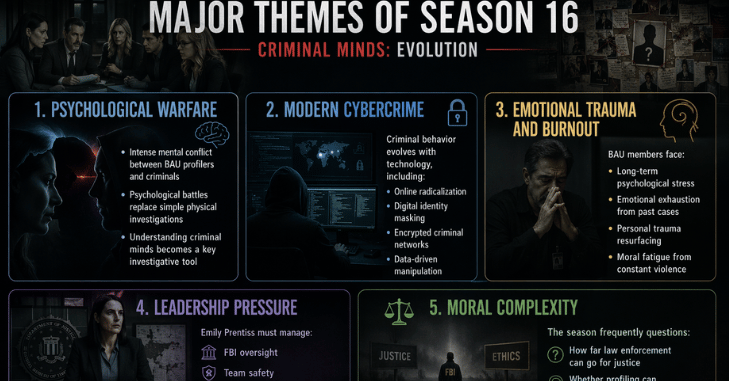
Psychological Warfare
- Intense mental conflict between BAU profilers and criminals
- Psychological battles replace simple physical investigations
- Understanding criminal minds becomes a key investigative tool
Modern Cybercrime
Criminal behavior evolves with technology, including:
- Online radicalization
- Digital identity masking
- Encrypted criminal networks
- Data-driven manipulation
Emotional Trauma and Burnout
BAU members face:
- Long-term psychological stress
- Emotional exhaustion from past cases
- Personal trauma resurfacing
- Moral fatigue from constant violence
Leadership Pressure
Emily Prentiss must manage:
- FBI oversight
- Team safety
- Ethical decision-making
- Operational risks
Moral Complexity
The season frequently raises questions:
- How far can law enforcement go for justice
- Whether profiling can predict or prevent all crimes
- The ethical limits of surveillance and intervention
Villain Structure and Antagonist Design
Season 16 introduces a major shift in its villain structure by moving away from the concept of a single serial killer and instead presenting coordinated serial killers operating under a shared system. These offenders are not acting independently but are linked through a broader framework designed and controlled by a hidden mastermind.
This unseen figure plays a central role in manipulating criminal behavior patterns, influencing how and when crimes are committed, selecting victims based on specific criteria, coordinating operations across different offenders, and even triggering psychological responses that drive the killers’ actions.
Production Style and Cinematic Approach
Visual Tone
Season 16 adopts:
- Darker color grading
- High-contrast lighting
- Realistic crime scene presentation
- Cinematic camera movement
Storytelling Style
- Slower, more suspense-driven pacing
- Emotional character focus
- Extended dialogue and profiling sequences
- Strong continuity between episodes
Realism Enhancement
The show increases realism in:
- Victim portrayal
- Criminal psychology
- FBI procedural accuracy
- Forensic investigation methods
Character Development Focus
Emotional Depth
Characters are no longer static investigators but emotionally layered individuals dealing with long-term trauma that has accumulated over years of exposure to violent and disturbing criminal cases. In Season 16, the BAU team is portrayed as deeply affected by the psychological weight of their work and emotional stability.
Relationship Dynamics
The season explores evolving dynamics within the BAU, particularly the importance of trust among team members as they rely on one another in high-stakes investigations. It also highlights leadership and hierarchy tensions, especially as decisions made under pressure test authority and responsibility within the unit.
Personal Struggles
Each character in Season 16 faces a deeply personal struggle shaped by their years in the BAU, as past trauma resurfaces during new and intense investigations. This renewed emotional pressure leads to increasing exhaustion, both mentally and psychologically, as they are continuously exposed to violent and disturbing criminal cases.
Audience Reception

Positive Feedback
- Strong return of the original cast
- Mature storytelling approach
- More realistic criminal psychology
- Improved cinematic production
Criticism
- Less episodic variety compared to the original series
- Slower narrative pacing
- Heavier focus on serialized structure
Importance of Season 16
Criminal Minds Season 16 is significant because it:
- Revives a globally popular crime series
- Updates storytelling for streaming audiences
- Introduces modern cybercrime themes
- Expands psychological profiling depth
- Shifts the franchise into a serialized narrative era
Conclusion
Criminal Minds Season 16 represents a bold reinvention of the BAU universe. By shifting to serialized storytelling, introducing network-based criminal structures, and emphasizing psychological depth, the season modernizes the franchise while maintaining its core identity. Elsewhere on the site: NT Live Hamlet.
With its darker tone, complex villains, and emotionally driven narratives, Season 16 stands as a defining chapter in the evolution of Criminal Minds and a strong example of how legacy crime dramas can successfully adapt to the streaming era.
Want to know about The Gilded Age Season 3 Check out our Entertainment category.
FAQs
Criminal Minds Season 16 (Evolution) follows the BAU as they investigate a highly organized criminal network made up of multiple serial killers controlled by a hidden mastermind. Unlike earlier seasons, the story is continuous and focuses on one large interconnected case across the entire season.
Season 16 shifts from standalone weekly cases to a serialized storytelling format, featuring longer arcs, darker themes, and deeper character development. It also introduces modern cybercrime elements like dark web recruitment and encrypted communication.
The BAU is led by Emily Prentiss and includes key members such as David Rossi, JJ Jareau, Luke Alvez, and Penelope Garcia, each contributing specialized skills in profiling, fieldwork, communication, and cyber intelligence.
The season explores psychological warfare, emotional trauma, leadership pressure, moral conflict, and the impact of modern technology on crime, highlighting both criminal behavior and the mental strain on investigators.
Season 16 revitalizes Criminal Minds for the streaming era by introducing a cinematic style, continuous storytelling, and modern cybercrime threats, while also deepening the emotional and psychological complexity of the BAU team.